

Julianne Moore Brings Down the House in ‘The Debut’
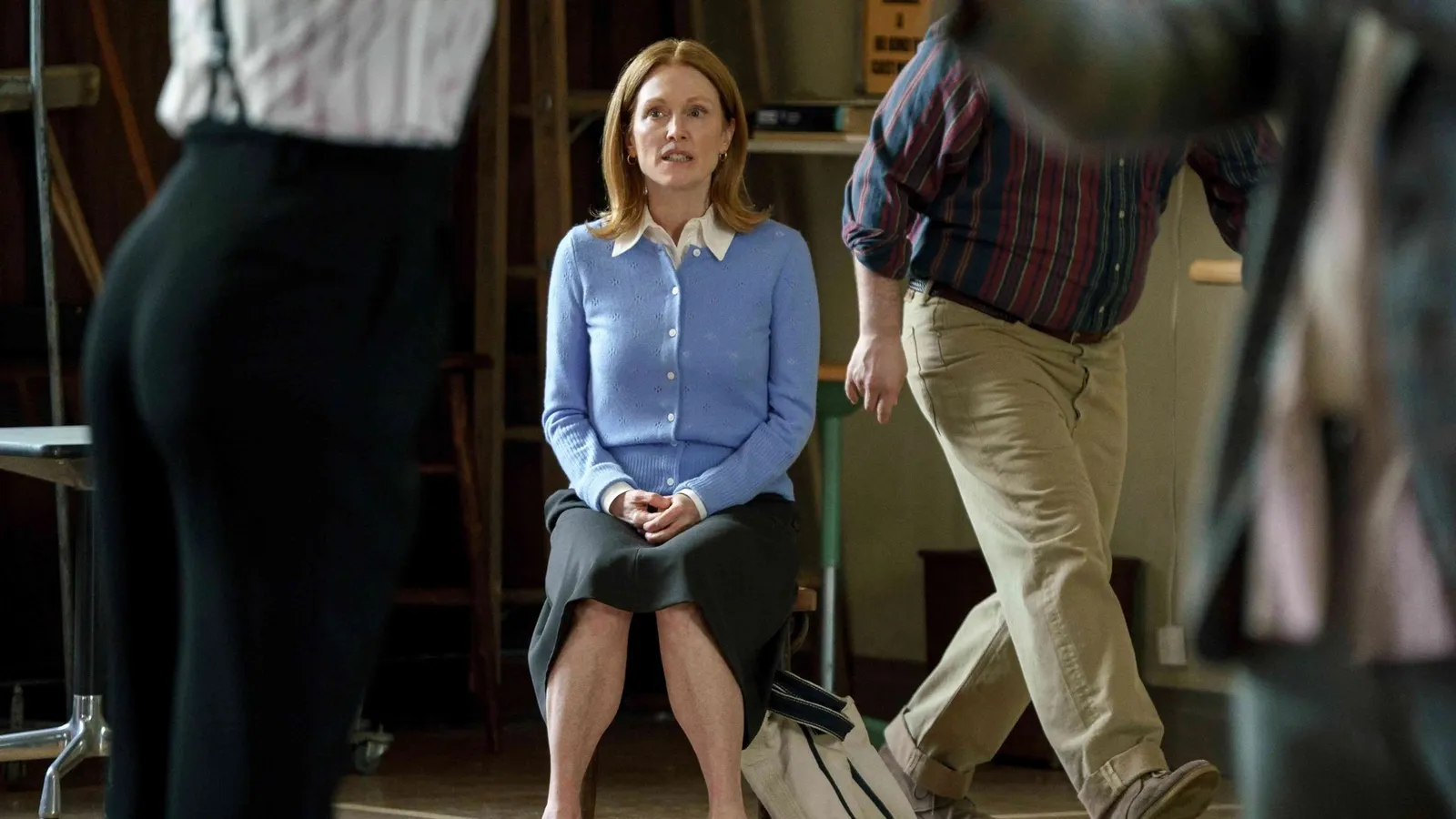
Jesse Eisenberg's third feature hands Julianne Moore a bit part in a community theater production and lets her play it like the role of her life.
Comedy is hard. There’s been a lot of hand-wringing in recent years about the disappearance of the original comedy from theaters. Maybe it’s part of growing up or just the way entertainment has evolved over the last 20 or so years, but the difficulty level for making a broadly popular comedy seems to be higher than ever. While The Debut, the third film from writer/director Jesse Eisenberg, isn’t the second coming of There’s Something About Mary, it contains a scene that had the entire sold-out theater laughing. And this wasn’t light chuckling or “oh, that’s so funny” type of laughter; this was about 500 people genuinely cackling at the screen. Seeing a single scene do that to an audience in 2026 is like seeing an endangered species in person. It’s the hardest I’ve laughed at a movie in a decade. It also just might be the exact scene that wins Julianne Moore her second Oscar.
I should mention, this all happens in the first 20 minutes or so. The Debut wastes no time getting to the point: we meet Mona Friedman (Moore) as she waits for her name to be called for a local theater production of the fictional play Nosy Neighbors. She bombs her first audition in front of Jerry (Paul Giamatti), the cantankerous but well-respected community theater director behind the production. But when theater legend Serena Cherry (Bernadette Peters) drops out of the role at the last minute (the part was “too small” for her), Jerry decides to give the part to Mona, the only other person who auditioned.
This is where the film could have slipped into something sappy. The premise practically begs for it: a woman with an unsatisfying home life discovers her passion for theater, and for living. Eisenberg has admitted the material is close to home. He has said the film is autobiographical, drawn from his own years in community theater and the people there who made him feel special, “just like what happens to Mona.” A director with less nerve would have made the warmer version of that memory. Eisenberg’s voice leans a bit darker, and he deploys it well. He’s a smart enough filmmaker to understand that this is a movie built around Moore, and that everyone around her lives in a heightened reality whose only job is to accentuate the central performance. Instead of dwelling on how Mona’s life outside the theater is crumbling, he gives us Tim Robinson-esque sketches of absurdity, like a running bit in which her husband, Howard (Patrick Fabian), can only be reached when he’s on the toilet.
Cinematographer Drew Daniels, known for his work with Sean Baker on Anora and Red Rocket, provides a distinct color palette that helps ground the insanity. Eisenberg wrote all seven of the fictional musical’s songs himself, and they all fit perfectly into the faux production. These are numbers a room full of amateurs would be thrilled to get their hands on, and the director never condescends to them.
Eisenberg’s first two features, When You Finish Saving the World and A Real Pain, were each built on a pair: a mother and son who can’t stand each other, two cousins on a Holocaust tour of Poland. Both are about a person who is exhausting to be around and the person stuck loving them anyway. In a sense, The Debut keeps that pairing in Mona and Jerry (despite some initial tough love, Whiplash this is not). Jerry shows an immediate compassion and tenderness for Mona, even as his methods and her madness grow more extreme. Giamatti is reliably excellent, particularly in how he reacts to the monster he’s creating. His face can go from stern to shocked to worried to stubborn in a matter of seconds, and the film gets a lot of mileage out of letting him do it in silence while Mona talks.
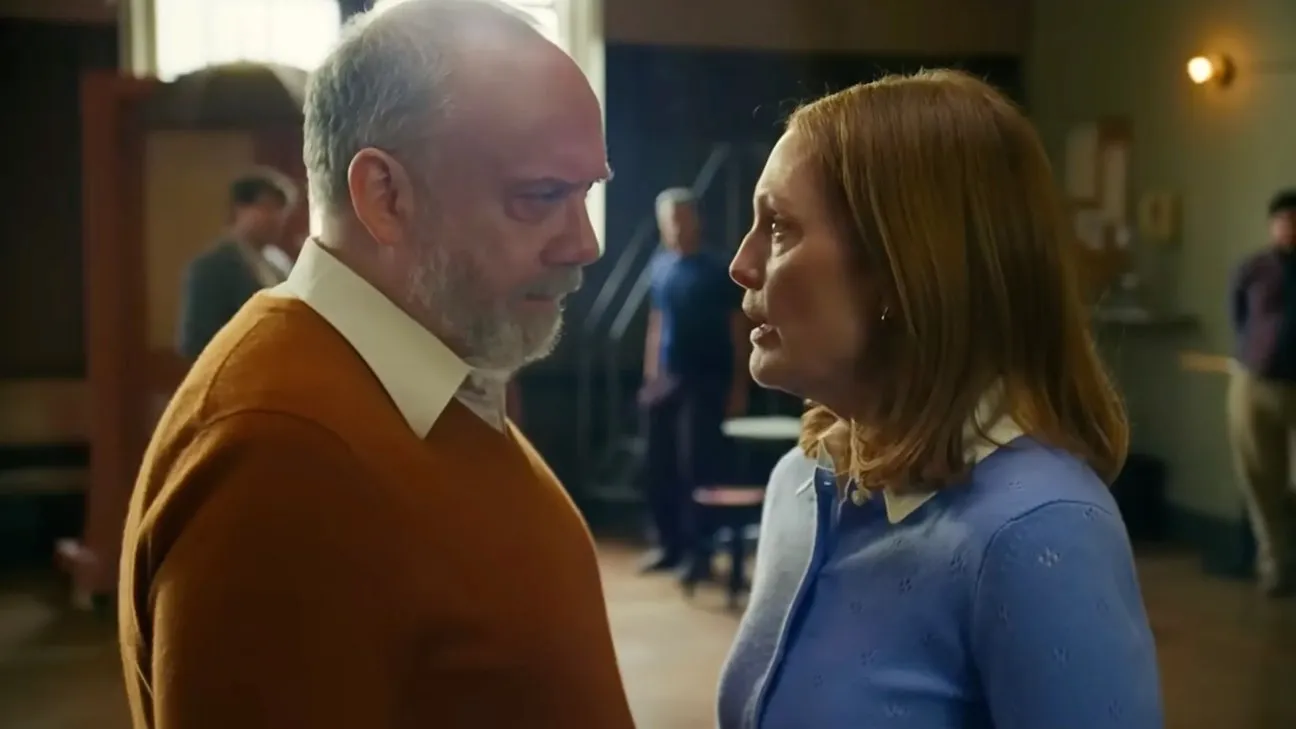
Jerry and Mona, in The Debut (2026)
But there’s no way around it. The Debut will be defined by its towering lead performance. It’s a one-woman show from start to finish. Moore injects Mona with an unhinged physicality that evolves as she transforms from fragile senior citizen into Daniel Day-Lewis. Eisenberg has said he wrote the film for Moore, who also anchored his first feature, and that kind of tailoring can be a trap. A part written for an actor can end up being a part that asks nothing of them (something you might argue happened to Kieran Culkin in A Real Pain). Here, his lead actor more than rises to the occasion. Moore is sensational in a performance that rivals the best of her career, giving Mona a level of humanity that lifts the character beyond an extended sketch. The film asks us to laugh at a woman who takes a bit part far too seriously, and Moore’s answer is to take the bit far too seriously herself.
When The New Yorker profiled Jeremy Strong in 2021, Adam McKay, the man behind half the studio comedies people are nostalgic for, explained why an actor who didn’t find Kendall Roy funny was exactly the right person to play him: “He’s not playing it like a comedy. He’s playing it like he’s Hamlet.” The line became a punchline about Strong, and while The Debut certainly has fun skewering method acting in general, Moore is doing the same thing with Mona. Mona doesn’t know she’s in a comedy, and Moore never plays it like she does either. Every choice she makes is weighted like a woman preparing for Lear, and that truly makes it about 12x funnier.
That’s the real power of The Debut, and it’s why the film will outlast its premise. Mona is handed the super and treats her like Lady Macbeth. Julianne Moore is in a comedy about community theater and (rightfully) treating it like the role of her life. Neither of them behaves as if the assignment were small, and the movie never once suggests they should. Comedy is hard because the shortcut is always right there: wink, mug, let the audience know you’re in on it. Eisenberg and Moore take the long way around, and the reward is 500 strangers cry-laughing at the same moment in 2026. You don’t get that by playing it like a comedy. You get it by playing it like it’s Hamlet.