
‘Wake in Fright’: a monster movie where the monster is… men
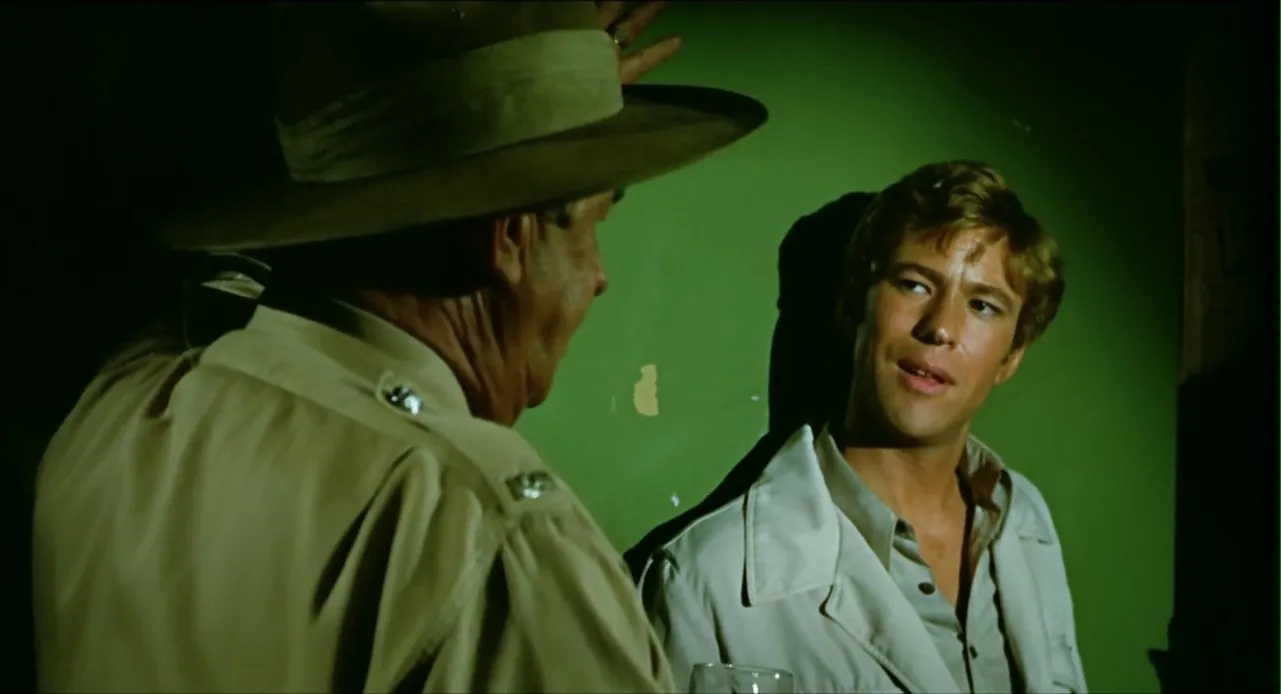
A stomach-turning filmic proof that toxic masculinity is enough to give us nightmares.
Being a big fan of Long Weekend (1978, Colin Eggleston), which I discovered almost by accident, I decided to look for more Australian thrillers this Halloween.
It is a whole universe.
I felt kind of uncultured realizing I didn’t know much about the Australian New Wave. Even though a bunch of movies I loved were part of it, I never thought of it as a creative wave. Then, to my delight, I discovered a concurrent, smaller and less well-behaved wave called Ozploitation.
Wake in Fright (1971, Ted Kotcheff) is one of its big titles (it is sometimes listed as Ozploitation, sometimes as Australian New Wave). It became an Australian cult classic after its original version went missing, a story similar to that of the Brazilian cult film Limite (1931, Mário Peixoto). It was eventually rescued in 2004 and restored for a new Cannes screening in 2009 (in the year of its release, it had competed for the Grand Prix at the same festival).
From the very beginning, something’s off, but you can’t quite put your finger on it. It’s in the tone, and also in the heat and the spaces, the big halls, the vast stretches of land. If you’re as drawn to no man’s land stories as I am, these stories where people live whole lives at the margins of everything, invisible to the whole world, their whole worlds invisible to us – you’ll probably like it too. I wasn’t at all familiar with the Australian outback, an immense burning landscape with a very low concentration of people. In some places the heat is so absurd that people live underground. Hell yeah.
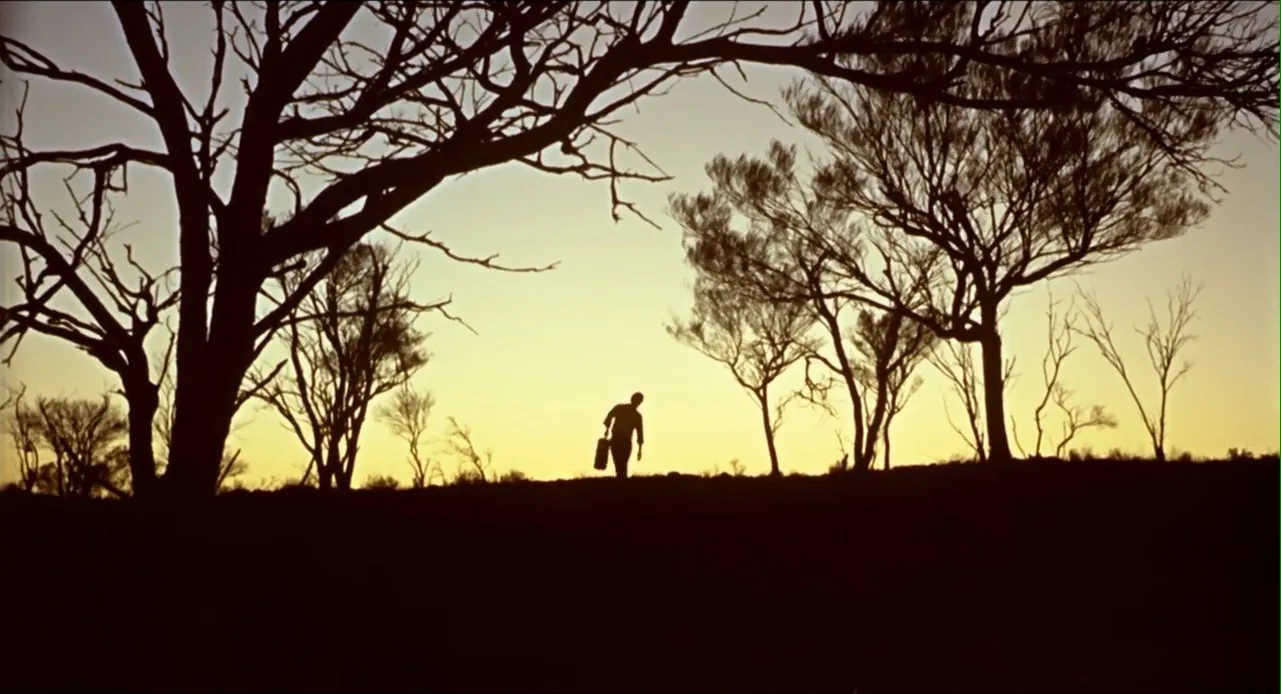
The Australian outback in Wake in Fright (1971, Ted Kotcheff)
It sits alongside other films of the same period, specifically the subgenre we can affectionately call “Honey, The Villagers Went Crazy”: The Island (1980, Michael Ritchie), The Wicker Man (1973, Robin Hardy), Straw Dogs (1971, Sam Peckinpah), The Blood on Satan’s Claw (1971, Piers Haggard), even Shivers (1975, David Cronenberg)! Anyway, all movies that show an outsider being absorbed by a crazy community, in most cases involving some level of forbidden eroticism. What is disturbing about Wake in Fright, though, is that Kotcheff does it without monsters, metaphors and allusions. The man takes his horror directly from reality.
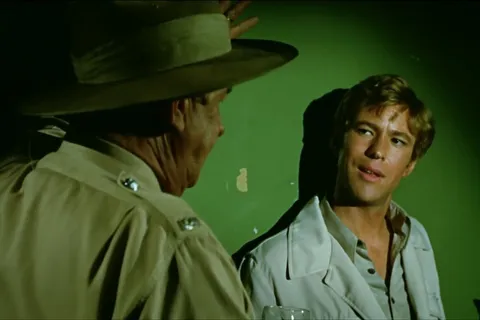
You notice it from the start. John Grant, the protagonist, is passing through a small town called Bundanyabba (or “The Yabba”, uh, so creepy!) on his way to Sydney to see his girlfriend. What we first see of the town is its empty spaces and immense, crowded bars where all you can see are male faces. An older man in a cop uniform approaches John, and the play of glances and the way he strikes up a conversation make you think of a seduction scene. All you can think of is a gay bar, but nothing is ever said explicitly: the homoeroticism is evident but never declared, disguised instead by alcohol, which is manifestly the evil force that won’t let John leave The Yabba. But the latent discourse is far richer.
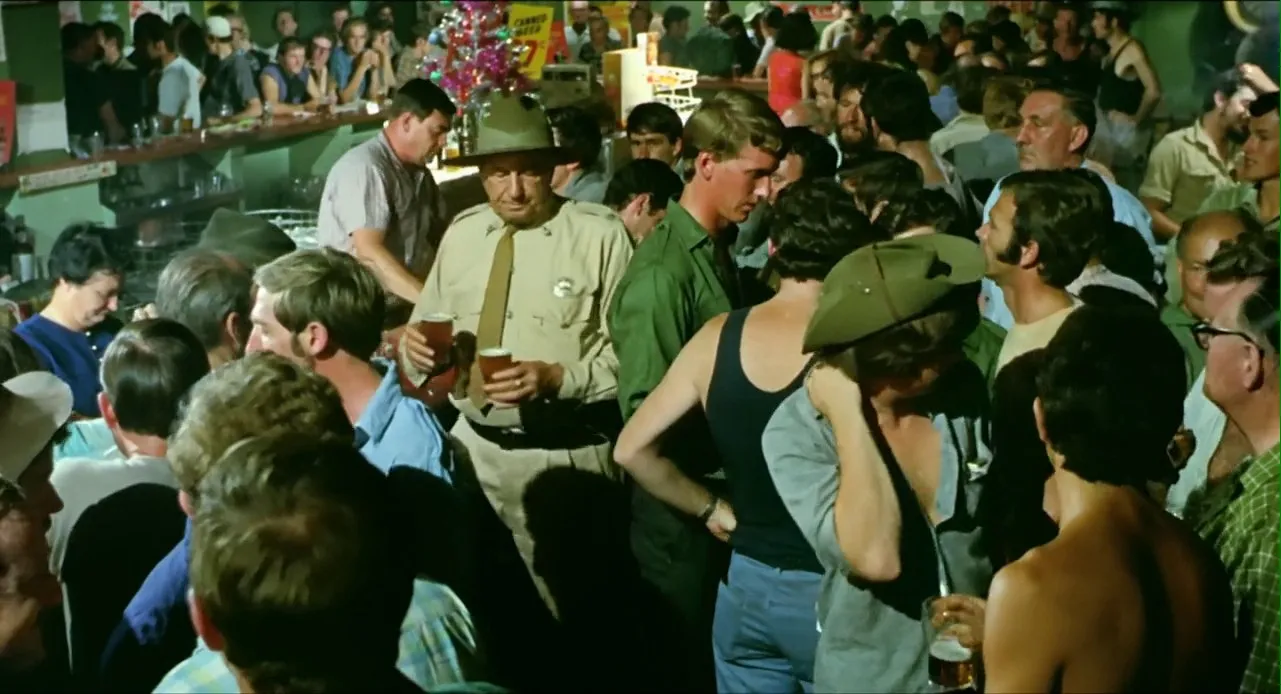
The all-male world of Wake in Fright (1971, Ted Kotcheff)
On the one hand, it’s one of the most crushing portraits of toxic masculinity I’ve seen in fiction. Men are depicted as ugly, drunk, loud, cruel, promiscuous, aggressive, dehumanized and dehumanizing creatures. If nowhere else, this is clearest in the hunting scene, which made twelve viewers walk out of the 2009 screening in Cannes, and which I wouldn’t recommend if you’re sensitive to this kind of content. I’ve seen few horror scenes like it. It’s not funny spooks, it’s real dark horror and dread. On the other hand, the film has something of a “descent” of a character into his own repressed homosexuality, depicted as a dirty pit from which there is no escape. The “wake in fright” that kicks off John’s ordeal comes in this wonderful shot of him waking up stark naked, his white cheeks facing us, just before he discovers the disaster that will keep him stuck in The Yabba. John seems repulsed by the men, but from time to time he seems to be… enjoying himself? He can’t leave for material reasons, but sometimes we wonder whether other subterranean reasons might be driving his actions. Some lines stick, in this sense. “The touch of his hairy hand offended you,” says the Doctor when they first meet, his curious look keeping the “but” implicit. Or a puzzling exchange when John leaves with Janette: “He prefers to talk to a woman instead of drinking?” one of the men asks, and the other answers knowingly: “A schoolteacher” (until not so long ago, teaching was seen as women’s work, so the line marks John as feminized). The contradiction between the condemnation of John’s perceived feminization and the evident homoerotic interaction between all these horrible men is the film’s main source of tension. It surfaces in scenes such as the one where he can’t go through with sex with Janette, or in the suicide talk that wraps up the film, so common among people who struggle to accept their gender identity or orientation.
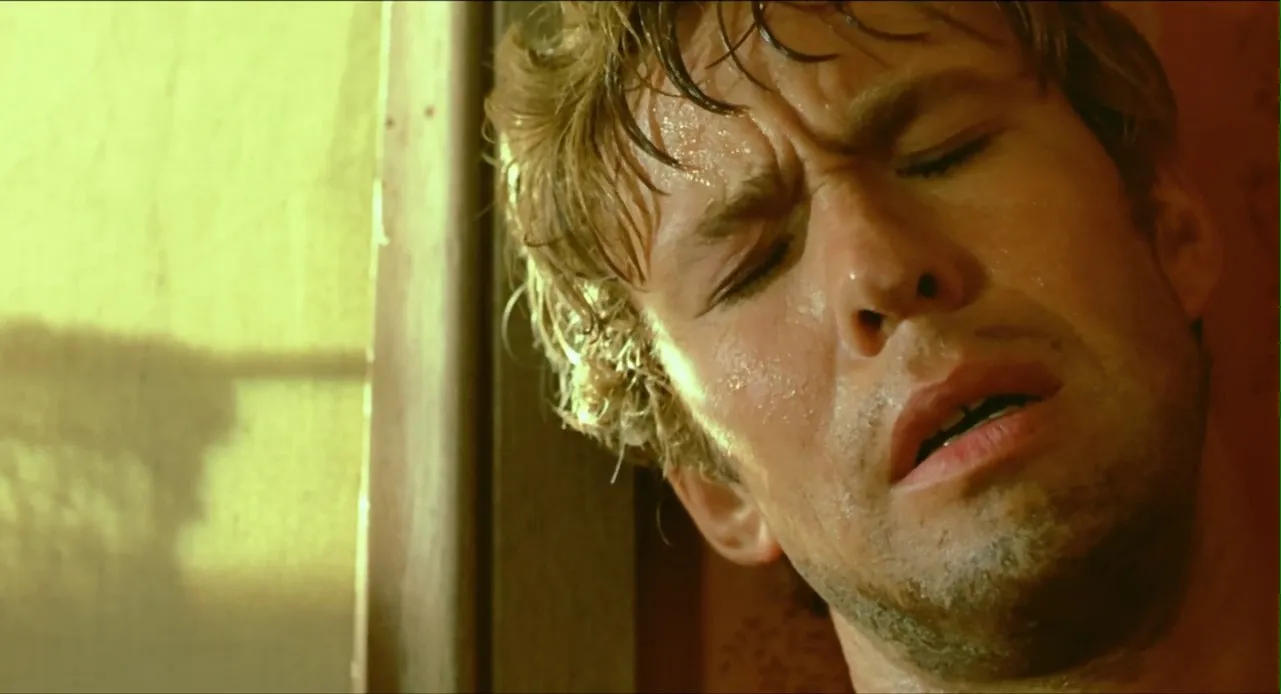
The alcohol, the heat, and Gary Bond’s great performance as John Grant
A vegetarian, Kotcheff filmed the hunting scene alongside a group of licensed professional hunters, and included the footage with the approval of animal welfare organizations. That gave me some relief regarding the depiction of animal suffering, but as for the masculinity conflict, the film could be read as homophobic just as well as a complex portrayal of living with internalized homophobia, done in a far subtler and scarier way than, for example, in the boring Leviticus (2026, Adrian Chiarella).
I choose to read it from the second angle.