
Should we keep watching ‘Michael Clayton’?
Soon, the films that defined a generation of millennials will be twenty years old. Revisiting some of them, we can ask which ones will still be watched.
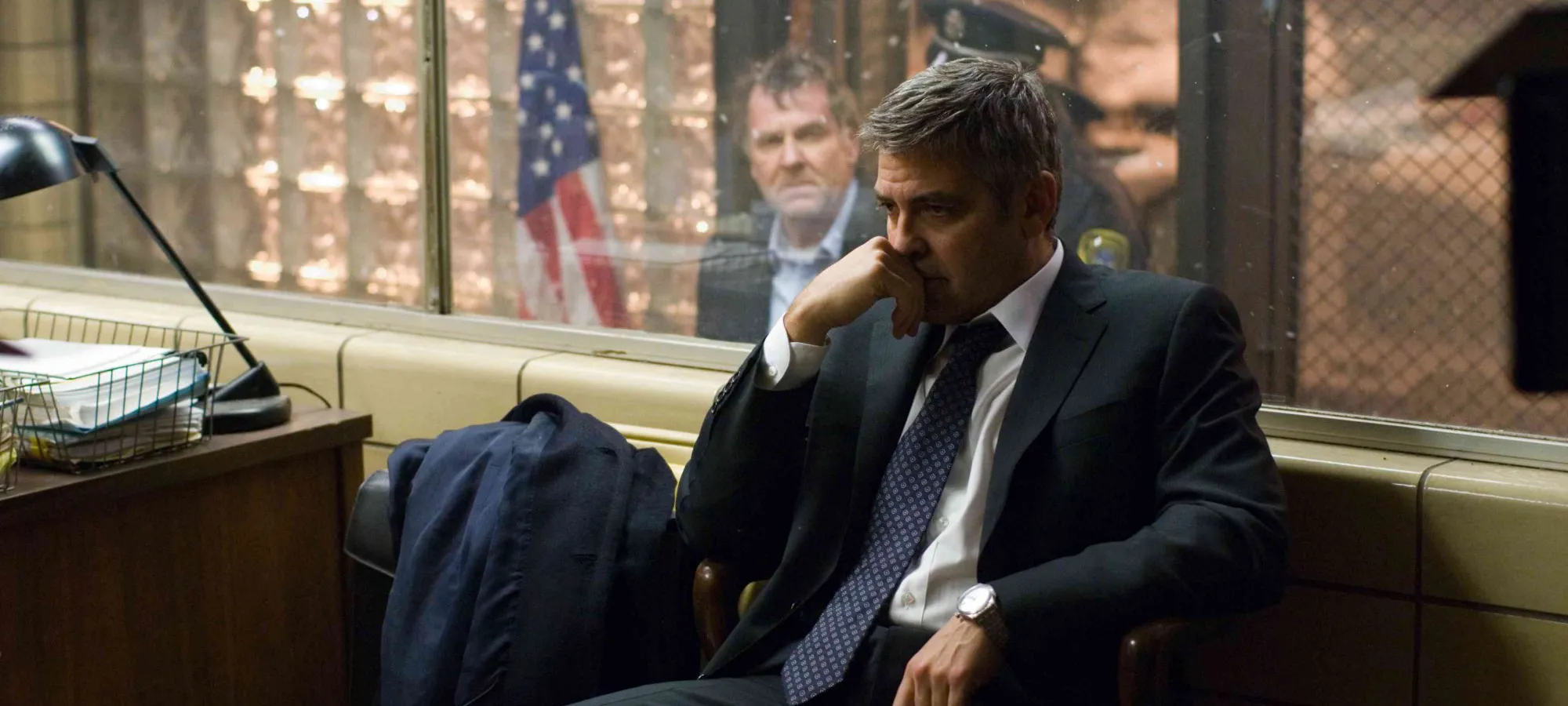
The love we nourish for a work of art is beyond our control. By definition, a film, a book, or a painting will pierce layers within us that we have no access to. It will cross shallow and deep values, as well as our artistic and cultural background. I can train my gaze to objectively understand what is good or bad in a film. But a significant part of appreciation is magnetic, immediate, and the final reading depends far more on that than on objective analysis. When a work inspires us, it does so by touching our identity and our story, and we react by trying to articulate in words the pleasure it made us feel. Pleasure in identification. We give it back, in a way. That is how a film grows in culture.
In this sense, I may not be the best person to say much about Michael Clayton. The film strikes me as too long, too wordy, and visually uninteresting, to the point where I had to call my mind back from the grocery list more than once. Office buildings, large impersonal flats, old white men in suits debating corporate matters, and an impressive palette of shades of gray make for a heavy combination to sit through for two hours. The baroque narration over urban images, the critique of ordinary life so common in male-oriented classics from the turn of the millennium (American Psycho, Fight Club), feels like a formula that has aged poorly, leaving me indisposed from the start. Even the oh-so-praised cold open seems there to justify a scene that, without this common narrative device, would be considered a poor deus ex machina. I know I can’t judge a movie from what it didn’t promise to do. It is, after all, a 25-year-old American law thriller. It isn’t its fault if its cold parade of men discussing money and influence didn’t capture a lot of my attention (just as, more broadly, corporate law matters in general). Yet I dare say I know why Michael Clayton will continue to be watched by new generations.
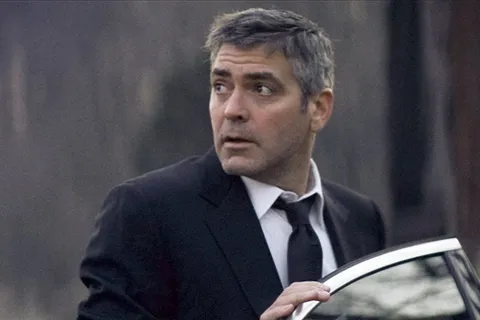
In this film, George Clooney’s discreet and elegant masculinity gives shape to an archetype that seems, at least to me, quite familiar: the ordinary citizen, the “janitor” with his broom in hand (as is repeatedly emphasized), the everyday worker who hides a man of extraordinary abilities that he chooses not to use. Yet this potential remains there, dormant but present, and it only takes a touch on his emotional side for his true, brilliant nature to surface (RIP John Wick’s dog). He is Johnny Guitar in the 1954 film of the same name, where the unassuming musician in the corner of a bar turns out to be the most dangerous man in the West. “Who is this man?”, asks a surprised blonde. He is also every detective of hardboiled fiction. I could make the effort to describe him myself, but Raymond Chandler does it far better in The Simple Art of Murder:
Down these mean streets a man must go who is not himself mean, who is neither tarnished nor afraid. The detective in this kind of story must be such a man. He is the hero, he is everything. He must be a complete man and a common man and yet an unusual man. He must be, to use a rather weathered phrase, a man of honor, by instinct, by inevitability, without thought of it, and certainly without saying it. He must be the best man in his world and a good enough man for any world. […] He is a common man, or he could not go among common people. He has a sense of character, or he would not know his job. He will take no man’s money dishonestly and no man’s insolence without a due and dispassionate revenge. He is a lonely man, and his pride is that you will treat him as a proud man or be very sorry you ever saw him. He talks as the man of his age talks, that is, with rude wit, a lively sense of the grotesque, a disgust for sham, and a contempt for pettiness. The story is his adventure in search of a hidden truth, and it would be no adventure if it did not happen to a man fit for adventure. He has a range of awareness that startles you, but it belongs to him by right, because it belongs to the world he lives in.
Any resemblance?
It’s easy to see why, watching Michael Clayton, my impression is that of encountering an old archetype, but without Bogart’s magnetism or the charm of wet, glimmering black-and-white cities. Let’s be honest: no one has ever truly understood what’s going on in The Big Sleep, so I don’t think the convoluted, pretentious, and uninteresting plot of Tony Gilroy’s film is really the issue. Perhaps it’s the relative absence of mise-en-scène events; at times, I get the impression that all anyone does in this film is move back and forth carrying papers. One scene even shows a spark of originality by replacing the papers with half a dozen fine baguettes. Countless scenes consist of a long dialogue, shot and reverse shot, between two static characters, and no moment to breathe. A film without a body, a film in which the only expressions of corporeality are signs of weakness or horror: the sweat of Karen Crowder (Tilda Swinton), who plays a woman whose only character trait is being too weak for the position of power she holds, while at the same time unscrupulous and cruel (will any woman ever be enough?); the bare torso of Arthur Edens (Tom Wilkinson), who strips during a nervous breakdown. By contrast, our time is deeply interested in bodies. So why will Michael Clayton continue to be watched?
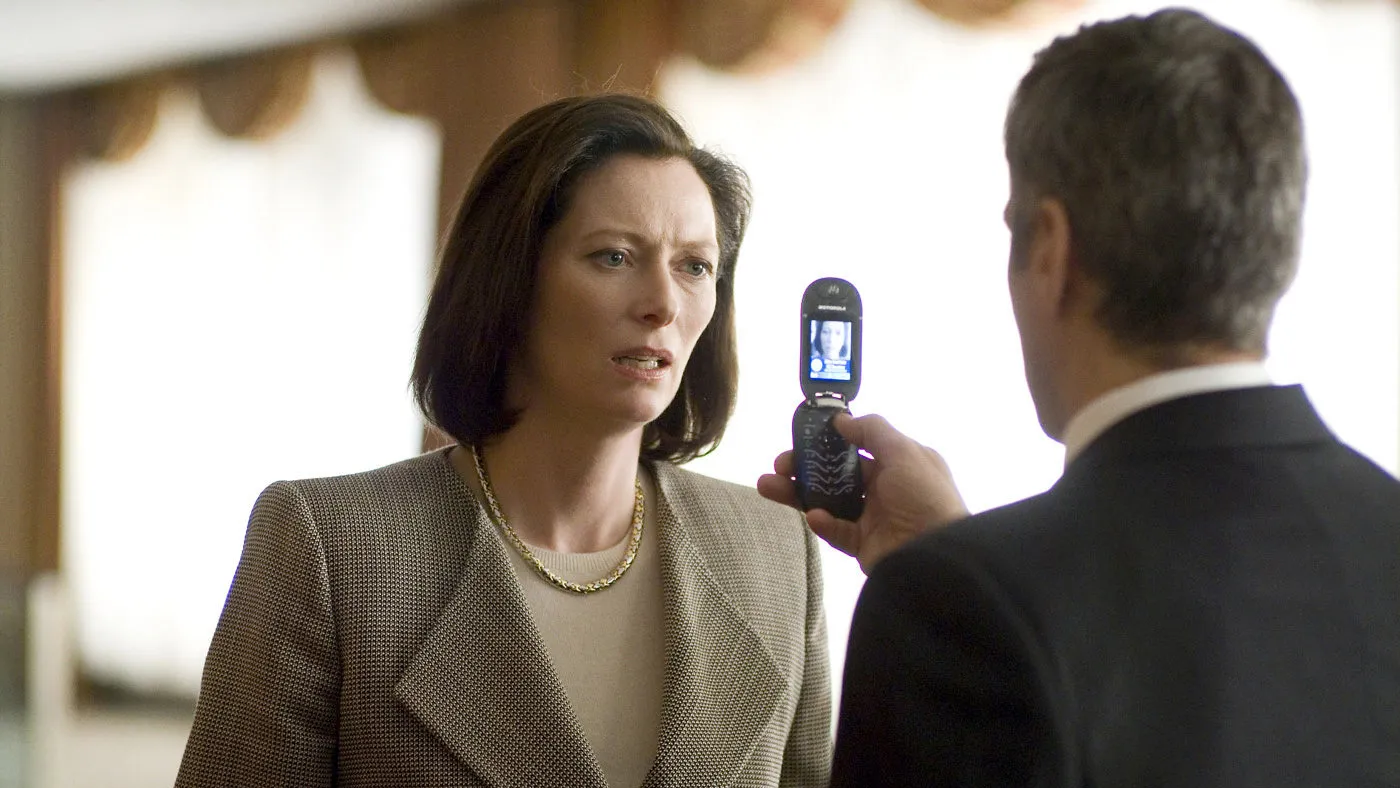
Tilda Swinton as Karen Crowder, at the far end of the machine, in Michael Clayton (2007)
The easy answer is that the fantasy of being special, of having a hidden or underestimated gift just waiting to emerge, never gets old. The fantasy of danger pulling us out of the boredom of the office building routine, the secret desire for catastrophe, for exception, for my car to explode in the middle of a workday. The crisis of masculinities also indulges in the old image of the lone wolf: discreet, elegant and efficient, seasoned with a touch of melancholy that only increases the mystery. But there’s a slightly deeper point to this story. Our protagonist is a solid silhouette amid two bodies that are falling apart. Edens is the image of the activist, of the idealist literally consumed by the absurdity of his encounter with the harsh reality of things. Crowder, on the diametrically opposite side, is consumed by the weight, and perhaps the guilt, of having to abandon all traces of humanity to feed the hunger of the Market Machine. Too much humanity, too little humanity. Michael Clayton stands in between these two poles: he carries both resignation and revolt. The trace of revolt left in him keeps him from surrendering; but the weight of resignation allows him to maintain some sanity and functionality. This in-between place, however, is not easy to occupy, as he’s caught between survival demands and the mourning of ideals. Even after twenty years, this conflict is still weirdly fresh. For that, this film could maybe survive more than others.
However, what still bothered me, and perhaps this is a symptom of the direction cinema has taken since then, was the impression that the film’s aesthetics align more with the coldness of the market apparatus than with the bodies trying to resist its crushing power. If there is any pleasure in this movie, it lies more in the construction of this efficiency than in sweat and tears. As an example, let’s take the murder scene [spoiler alert]. We are very accustomed to conventional deaths in cinema, where the victim is shot squarely in the chest and falls to the ground, arms wide open, kicking up dust. Against the cliché, Alfred Hitchcock chose to film the obstination of life in the long, silent murder of agent Gromek by Professor Michael Armstrong (Paul Newman) and a random peasant (Carolyn Conwell) in Torn Curtain (1966). The charm of the scene lies precisely in the fact that the killers are “amateur assassins,” that is, not professionals. This makes the scene stretched, painful, leaving the two killers exhausted, injured, panting. Gilroy’s depiction of death is different. It is a two-and-a-half-minute sequence shot. In it, we see two specialists, two technicians of death, tasked with ending Tom Wilkinson’s character’s life as if they were turning off a complex machine. The disposable caps are fascinating: entirely understandable in a murder context, we presume, preventing hair from falling and leaving traces for forensic analysis. Yet they go against the entire cinematic aesthetic of the hitman, from the 1930s gangster with his fedora to the ninja swimsuit; now they wear transparent disposable caps, like a food engineer. Now, we no longer fantasize about the violent explosion of the underworld; we fetishize the discipline, coldness and efficiency of these ideal workers, workers without values, without feelings (they evolved up to Michael Fassbender’s character in the irritating The Killer, 2023, by David Fincher).
Without music, relying only on two or three terrifying sounds and short, functional phrases exchanged between the two killers, the sequence shot is the ideal format. And this, not because it heightens realism, but because it serves as a proof of performance (and is a performance in itself). There is no hesitation or false gesture. The victim has no chance, he is not even given the opportunity to defend himself. It is a murder without explosions, punches or violence; a clean death, showing the fragility of the human body in the face of the technical precision of money-bought deaths. Two gestures at the start completely immobilize him: a taser shock and a spray into his open mouth. The injection between the toes (“you better hit it”) finishes the job, and the gloved finger touches the jugular in a distant, unpassioned manner: one more procedural gesture among many. Far more frightening than a pool of blood.
On three occasions, however, the camera suggests that it also occupies an intermediate position. It is as if, in the displacements of the sequence shot, its precise choreography echoes that of the two technicians. At first, when the two carry Edens’ body, the gaze slides toward his face and his wide, dumb eyes. It makes us feel how powerless he is, it brings us a spark of empathy. Then it “resumes” its function, as if it were the third member of the assassin team. Yet, later, at the precise moment of his death, it pulls back to include the movement of the hand allowing the last tremor of life to pass, and, more significantly, it remains with the corpse after the two technicians leave. Like its protagonist, Gilroy’s camera floats in an intermediate, almost contradictory position between coldness and empathy. A position, I would say, loose; a spineless aesthetic proposition; a coward gaze.

Had many lives, including screenwriter, cinema professor and goth teenager. Brazilian, drawn to intense movies, with low tolerance for biopics.