‘Michael Clayton’ and the Complicity of the Janitors
A lawn too green to be real, a neighbor who worked at Monsanto, and the working-class janitor at the center of Michael Clayton. On who carries the blame.
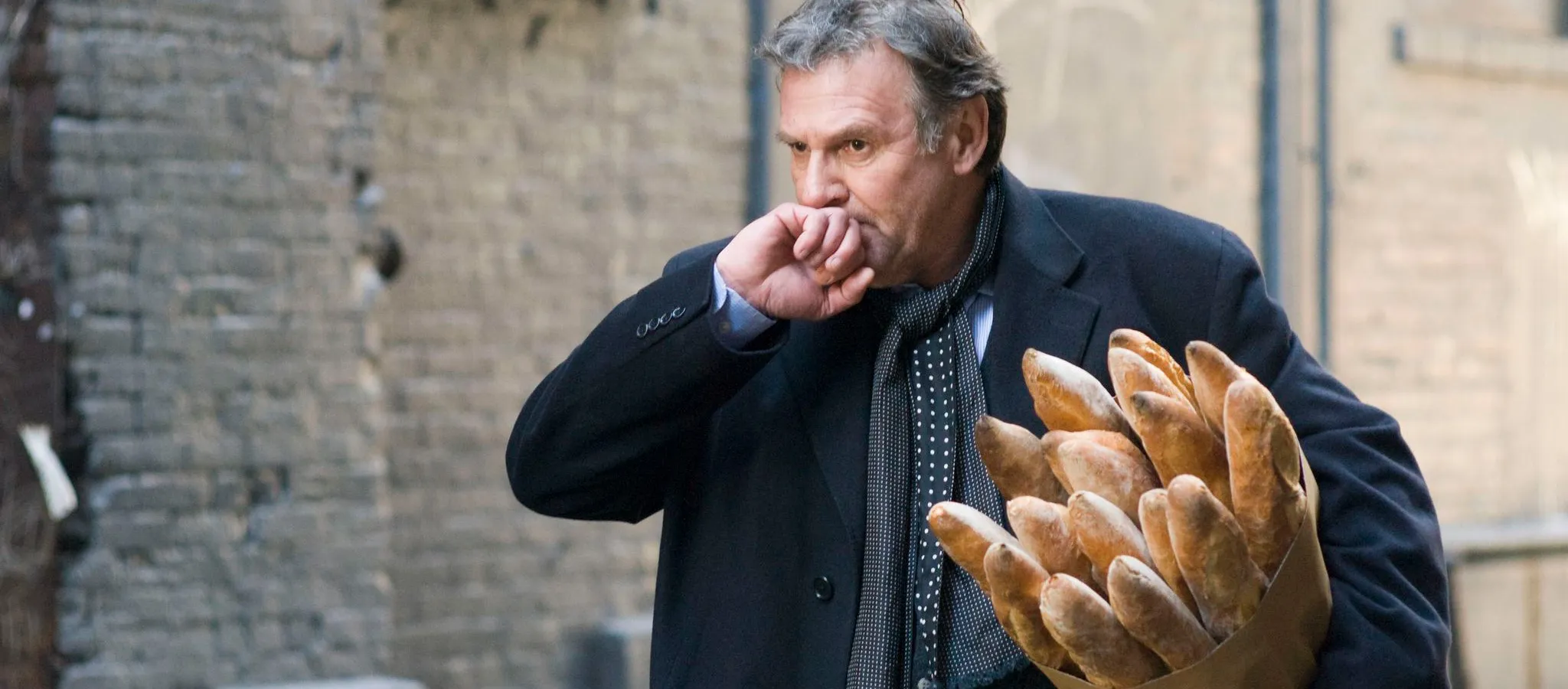
Suzanne’s lawn was a problem for me. My neighbor’s grass was a shade of green not found in nature. It was so lush and immaculate, it was fucking suspicious, like at any moment it could turn into the opening scene of Blue Velvet. My lawn, separated by a thin strip of uneven property line, was brown, patchy, and full of dachshund poop landmines. In the suburbs, your lawn is a scorecard. It tells everyone how competent you are, whether you belong, whether you care enough to compete in the unspoken neighborhood dick-measuring contest. You don’t win the Lawn Wars by playing fair; you win by having the time, the equipment, the money, and maybe one other thing.
Suzanne worked as a biochemical engineer at Monsanto, an agrochemical mega-corporation headquartered in Creve Coeur, Missouri, about 15 minutes away from my hometown in the suburbs of St. Louis. Along with Anheuser-Busch and McDonnell Douglas, Monsanto was part of three companies that fueled the St. Louis economy for the better part of the 20th century. I am not exaggerating when I say that everyone in the city had at least one family member or neighbor who made either beer, airplanes, or mutant tomatoes. By the 90s, Monsanto had helped turn the small town of Creve Coeur into one of the wealthiest zip codes in the state. Mansions sprung up from farmland, SUVs replaced pickup trucks. Working at Monsanto was a sign of success. But you didn’t have to dig deep in the fertile Missouri soil to find some parasites.
The list of chemicals Monsanto once produced is almost comically evil: an insecticide that punctured a hole in the ozone layer and drove the Bald Eagle to near-extinction, a bovine growth hormone that caused “severe and unnecessary pain, suffering and distress” for cows, and Agent Orange, which was used by the United States military as a chemical weapon during the Vietnam War. But Monsanto’s largest source of revenue and ultimate source of its downfall was Roundup, a weed killer that has been found to give people cancer. In 2020, Monsanto’s parent company agreed to settle over 100,000 lawsuits claiming Roundup caused cancer for between $8-10 billion. Suzanne’s lawn was a problem.
“An organism whose sole function is to excrete the poison, the ammo, the defoliant necessary for other, larger, more powerful organisms to destroy the miracle of humanity.”
Michael Clayton begins with Arthur Edens (Tom Wilkinson) experiencing a crisis of conscience—a “moment of clarity”— over the fact that he has spent a large percentage of his adult life as legal counsel for U/North, a fictionalized version of Monsanto that also knowingly exposed innocent people to a carcinogenic weed killer. Following a brief vacation from his bipolar medication, Arthur has decided he’d rather burn it all down than live with the guilt of continuing to protect his biggest client. This is all communicated in a breathless, nearly 3-minute voiceover—an astonishing performance by Wilkinson who delivers lines like “I have breached the chrysalis” with just the right balance of conviction and crazy.
We hear Arthur chewing the hand that feeds him, but we don’t see him. Nor do we see the person he’s talking to, his longtime colleague, Michael Clayton. In fact, in a film from a first-time director sold largely on George Clooney’s face, the first people we see on the screen are (in order): a man mopping, a woman vacuuming, and a junior associate pushing a mail cart full of photocopied settlement briefs (somehow only the second most prominent mail cart scene of 2007). “The smaller the mess, the easier it is for me to clean up,” Clayton says when we’re finally introduced to him on a late-night house call to advise a wealthy man who hit someone with his Jaguar. Tony Gilroy’s directorial debut is a corporate conspiracy thriller that moves with the urgency of his Jason Bourne movies, full of humorless men and women in dark rooms trying to clean up and cover up their trails of greed and destruction. But more than that, it’s about the complicity of the janitors.
Michael: I’m not the enemy.
Arthur: Then who are you?

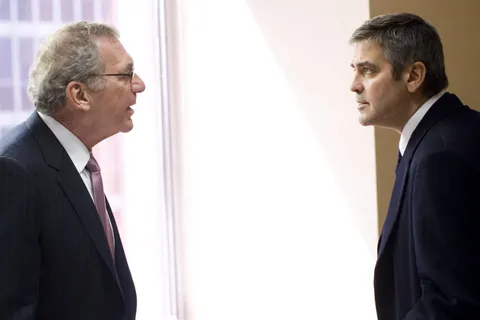
Sydney Pollack as Marty Bach: complicit so long he mistakes it for wisdom, in Michael Clayton (2007)
The mail cart eventually arrives at the last lit office in the tower, where Marty Bach (Sydney Pollack) and his henchman Barry (Michael O’Keefe) oversee a hive of lawyers disinfecting the evidence of their own contamination. Pollack gives Marty the calm, menacing authority of a man who’s been complicit so long he mistakes it for wisdom. His counterpart at U/North is Karen Crowder (Tilda Swinton), a sniveling corporate lackey desperate to appease her boss (Don Jeffries—just an excellent name for an American CEO; no notes). Both Marty and Karen have knowingly compromised their morals, and Giroy doesn’t hesitate to show them at their most evil and pathetic. Barry introduces the reporter on the phone as “that cunt from The Wall Street Journal.” Karen’s introduction, where she rehearses her corporate talking points in a mirror while dabbing her armpits dry, deliberately borders on grotesque in its intimacy.
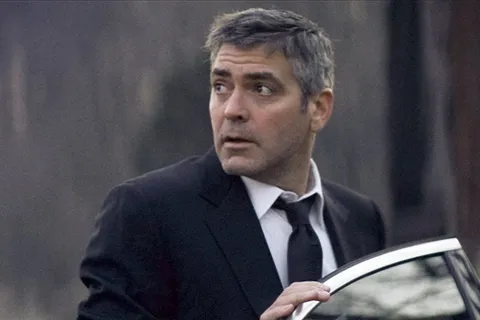
If Marty and Karen are avatars of white-color crime, Michael Clayton is the working-class punching bag sweeping up the rubble spilling onto their marble floors. While we meet the lawyers at the top of a glass tower, we meet Michael in the basement of a poker game in Chinatown. One brother is a police officer, another a recovering addict. He can’t pay the bills for his failed bar venture. As the longtime “fixer” at Arthur’s firm, he carries himself with the hunched-over shoulders of a man punishing himself for things we don’t witness but can see written all over the ragged, sunken face of one of America’s most recognizable actors. Clooney dials back his default wise-ass smarm as much as he is capable, playing Michael with a competency that barely hides a deep contempt for who he is, what he does, and the people he does it for. Gilroy’s camera, like cinematographer Robert Elswit’s light, never flatters him. He’s always half in shadow, neither saint nor sinner, but clearly a man too smart to pretend he doesn’t know what he’s part of.
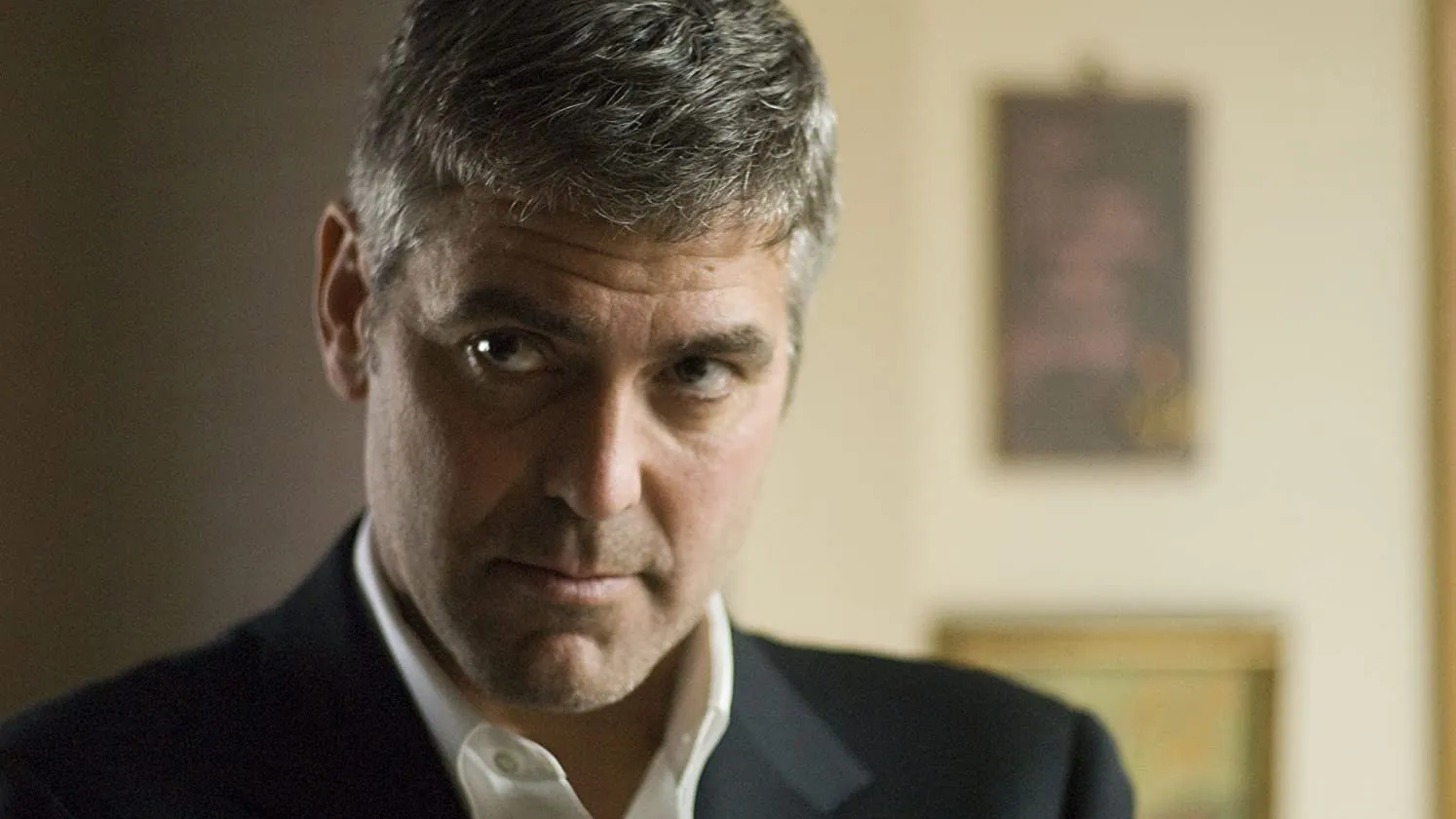
Clooney half in shadow, which is where Robert Elswit keeps him, in Michael Clayton (2007)
Saying this is a film of performances might seem like a dig at Michael Clayton’s aesthetics, but it’s important to note just how vital and compelling each supporting role is. Swinton, who won the Oscar for this role, may fumble the American accent but nails the pathology. She plays Karen like a malfunctioning Blade Runner android, her body running on a perpetual level of fight-or-flight panic and hotel instant coffee, her voice glitching into generic corporate-isms like Siri reading a PowerPoint presentation. Her final breakdown, the way she delivers the line, “You don wan the money?” is devastatingly sad because of its desperation. It feels like capitalism itself is short-circuiting. Karen isn’t evil because she chooses to be; she’s evil because she can’t imagine a world where she’s allowed not to be. Even the smaller roles make the very most of their limited time. The way Merrit Weaver, woefully underdeveloped as the impetus for Arthur’s awakening, says, “I got on the plane,” helps close a crucial plot hole. As written, it’s a little thin. As performed, it lands that plane.
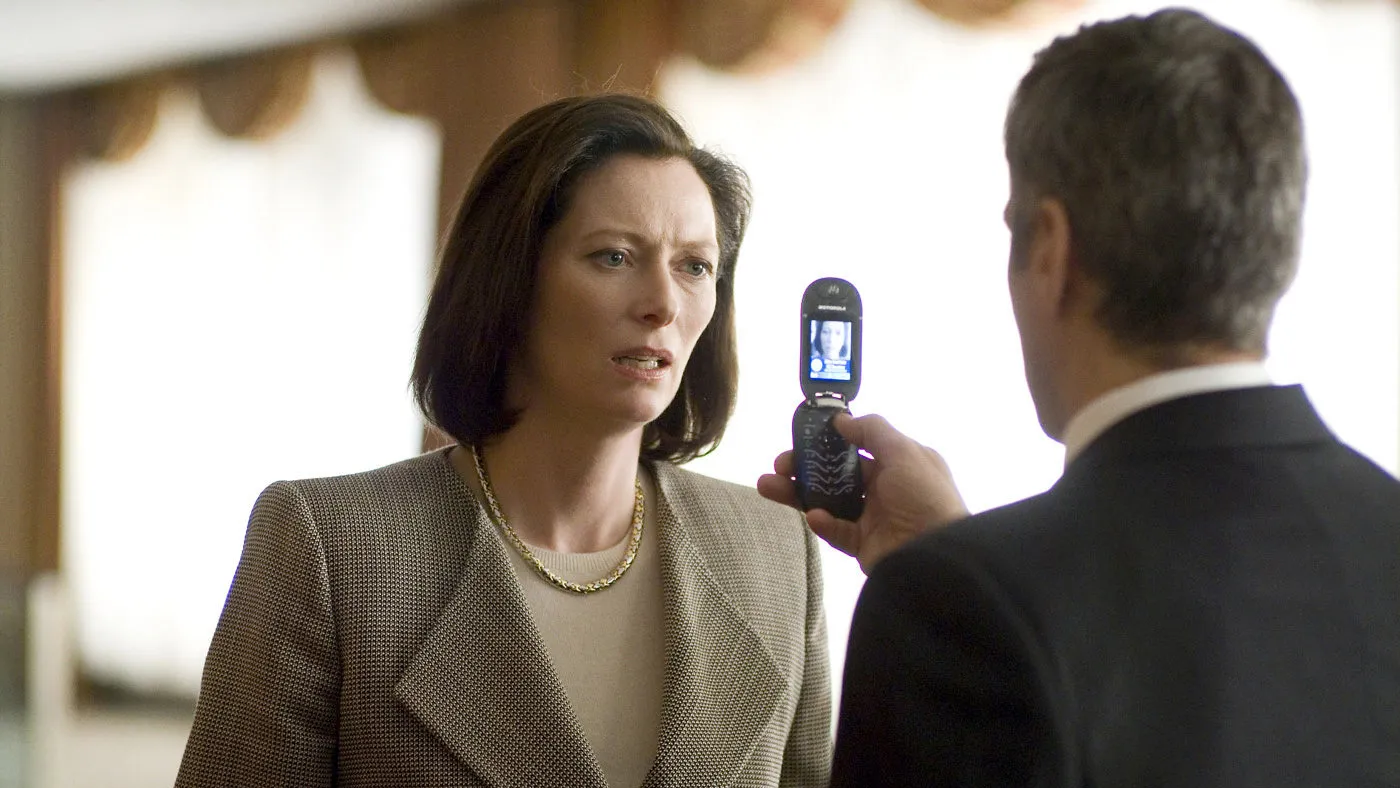
Tilda Swinton as Karen Crowder, who cannot imagine a world where she is allowed not to be this, in Michael Clayton (2007)
Robert Elswit’s cinematography and James Newton Howard’s pause music-inflected score work in tandem to trap the film in a kind of corporate submarine. Elswit shoots a world of perpetual dusk: liminal spaces where the air feels recycled, daylight dimmed by the glass of anonymous office buildings. This is not every-shot-a-painting work from Elswit who is more than capable of that kind of showy, in-your-face work. He’s cited 70s thrillers like All the President’s Men and The Parallax View as inspiration, and you can see it in his use of available light, low color saturation, and deep shadows, all of which are central to the film’s mood. Howard’s music hums beneath it like sonar, low and rhythmic, a pulse echoing from underwater. Together, they create the film’s oppressive, conspiratorial mood before finally, at the very end, both begin to lift. The palette warms, a contemplative piano emerges, and the film finally exhales. Natural sunlight flickers through the taxi window. The beige conference room gives way to color, the sound of escape replacing the hum of containment.
Just drive
Gilroy’s opinions on the ruling class in America are not very subtle (he will go on to write about a much more visible working-class rebellion). Capitalism doesn’t reward moments of clarity; it punishes them. That machinery eventually kills Arthur. The two hitmen who murder him move with the same cold efficiency that Marty Bach uses to dismiss a reporter on the phone: firm, workmanlike, and completely without conscience. It’s a truly chilling scene in its matter-of-factness. This is violence that is indistinguishable from office work. We hear no noise, barely any struggle, just method. Before they leave, they frame the scene as an overdose and check his pulse one last time.
While Suzanne’s flawless lawn existed at the cost of someone else’s health, no one blamed Suzanne. Most of us are too busy trimming the edges and bagging the clippings to see what’s really fertilizing the ground beneath us. Taking a moral stance often requires deep sacrifice, and money often silences progress. Michael Clayton finds redemption through escape. The only way to beat the system is to stop moving inside it, to step away before the car bomb goes off. When Michael finally corners Karen in that hotel corridor, it isn’t a showdown between good and evil. It’s the end of a long, quiet awakening. He’s still the janitor, but for the first time, he refuses to clean up someone else’s mess. Clooney can’t help but flash a glimmer of his 1,000-megawatt charm, but he largely plays it without triumph, just exhaustion. His final taxi ride—silent, blank-faced, the camera watching him dissolve into traffic—feels like a man finally free from the system that murdered his friend. Suzanne died of cancer in 2017. Her husband moved back to his family’s hometown, and we got some new neighbors. I’m told their lawn is immaculate.
Film obsessive, photographer, and former Blockbuster Video clerk, currently living out every creative's dream of working in digital marketing.