


Wagner Moura is everywhere
Trois Couleurs put him on the cover and called him the chameleon. Brazilian audiences have known for two decades, and mostly did not notice him doing it.
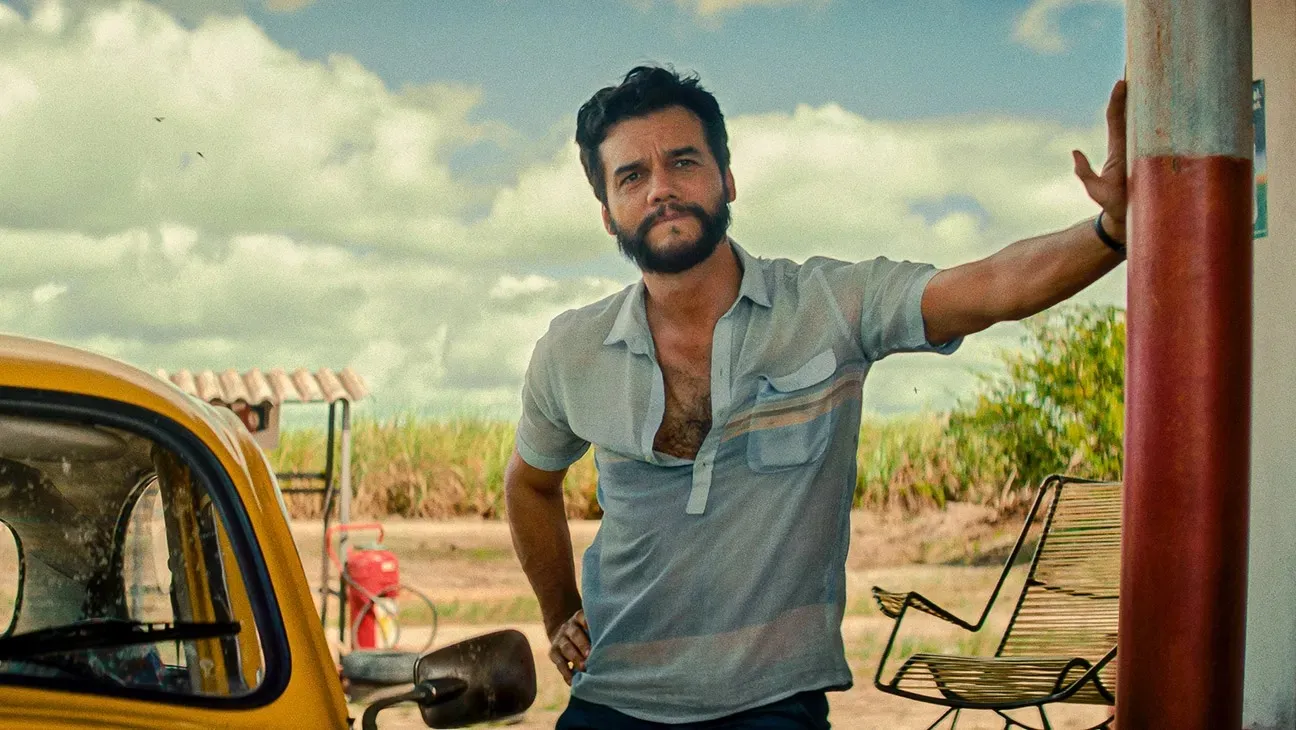
“The Chameleon”: that’s how French magazine Trois Couleurs introduced Wagner Moura on their December 2025 cover. They spotted what Brazilian audiences have known for a long time: that Moura is not a one-character actor (a pointed observation Michael Fassbender might want to sit with).
As a Brazilian viewer, watching Wagner Moura during this awards season feels like spotting a cousin at a fancy party on television. Someone from the family, right there, speaking English, sharing a magazine cover with the international it-boys of the moment, chatting with Tilda Swinton, walking red carpets. For Brazilian audiences, at least those of my generation, Hollywood felt so far removed from our reality that, despite my genuine admiration for Kleber Mendonça Filho and Moura, there’s still a background feeling that I’m watching a post-colonial version of The Beverly Hillbillies. And yet: Wagner Moura nominated for Best Actor, The Secret Agent nominated for Best Picture (not just Best International Film!).
Above all, Wagner Moura feels like family because, wherever you look in Brazilian film and television, he’s there. But quietly, sometimes so quietly I didn’t even notice him.
When I was 17 and embarked on a personal project of watching more Brazilian films while preparing myself to apply to film school, I used to watch everything I could get my hands on. That’s how I ended up in a tiny arthouse cinema, watching Saneamento Básico surrounded by local citizens enjoying their retirement. Jorge Furtado, who had already changed my life once with his short film Ilha das Flores (a staple of Brazilian history classrooms), directed this comedy that looks unassuming at first glance. In it, a group of ordinary people in a small Southern Brazilian village decide to make a film. The village has no sewage system and the infrastructure costs are steep, but a film contest with a cash prize convinces the community to try their luck, and they set out to shoot a B-movie called O Monstro do Fosso. Wagner Moura plays Joaquim, a sweet, devoted husband who becomes the steady anchor for his wife Marina’s newly discovered creative energy (played, for those keeping score, by Fernanda Torres, last year’s awards darling).
Even back in 2007, Joaquim struck me as a different kind of masculinity than what we were used to seeing on screen, and that’s mostly thanks to what Moura brings to the role: funny without being ridiculous, the kind of character who makes you smile with warmth, not condescension. At that decisive moment in my life, the film opened up a new vision of cinema for me. Beyond the grand spectacle, beyond the “real cinema” being made out there in Europe or in the States, cinema could also be some sort of play, something you build together, right here, among friends. Cinema as community, and consequently, cinema as political tool. Overall, the film fits neatly into the broad category of meta-cinema, or reflexive cinema. Think of Be Kind Rewind (Michel Gondry, 2008), which shares a similar spirit.
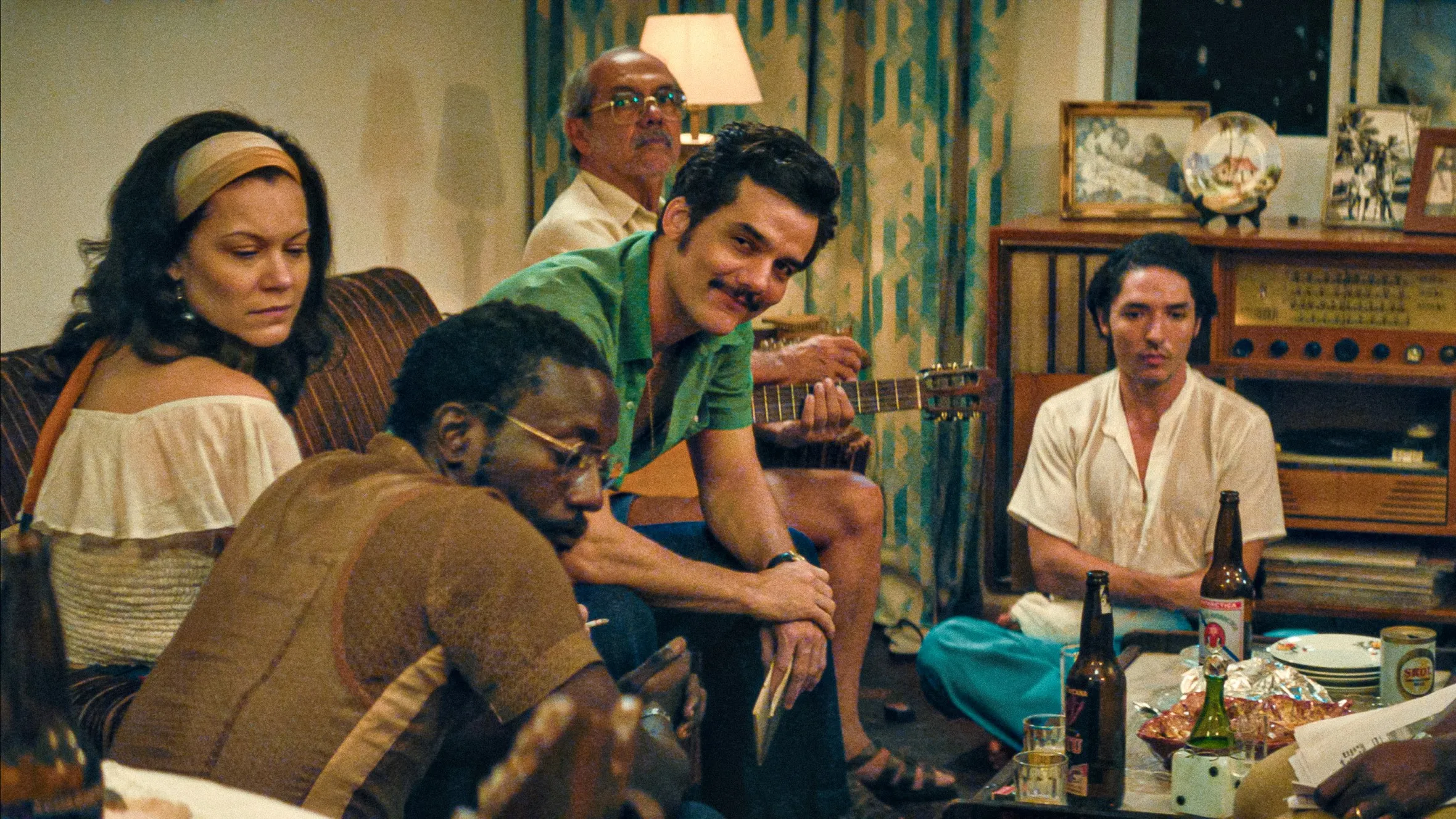
Moura among the ensemble in The Secret Agent (2025)
Imagine my surprise, then, when exactly three months later I watched the same Wagner Moura embody Captain Nascimento in Elite Squad. In Saneamento Básico, we had seen Moura’s soft curls, his slightly rounded cheeks, his plaid flannel shirt, the fluffy hat with ear flaps. The gentle smile, the slight slouch, an unshaved face, some hesitation in his gestures. Captain Nascimento is the exact opposite: rigid, dressed in the BOPE’s black uniform, broad shoulders riding up toward his ears, a hard stare, a tight jaw. Even his face seems different: the angular, tense jawline of Captain Nascimento is simply not the same as the soft, rounded face of Joaquim. And yet it’s the same person.
I remember the shock clearly. Elite Squad was a far bigger commercial hit than Saneamento Básico, so I spent weeks dragging everyone around me to watch Furtado’s film so I could say that “it’s the same person!!!”. And once I spotted Moura beneath his chameleon disguises, I started seeing him everywhere. He’s in Cacá Diegues’s Deus é brasileiro (2003) — Diegues being one of the main directors of the Cinema Novo movement of the 60s and 70s — where Moura plays Taoba, a classic Brazilian archetype: the malandro, the loveable rogue. When God, played by Antônio Fagundes, comes down to Brazil to find a substitute to take care of the universe while he goes out on vacations, it’s Moura who greets him. In Carandiru, the adaptation of Dr. Drauzio Varella’s memoir about his work preventing the AIDS epidemic inside what was Latin America’s largest prison, Moura played Zico, a character too gentle to be a criminal, too criminal to have a normal life, eventually swallowed by drugs under the weight of his own inadequacy. He’s in Carga Pesada, the beloved road series about two truck drivers crossing the country (“é uma cilada, Bino!”), playing Bino’s son Pedrinho. Being from Bahia himself, he’s in Ó Paí Ó, a cinematic monument to Bahian culture. He’s there alongside Rodrigo Santoro in Behind the Sun, by Walter Salles. He’s young Juscelino in Juscelino Kubitschek, about the Brazilian president who built our capital from nothing. Wherever you look, man. He’s there.
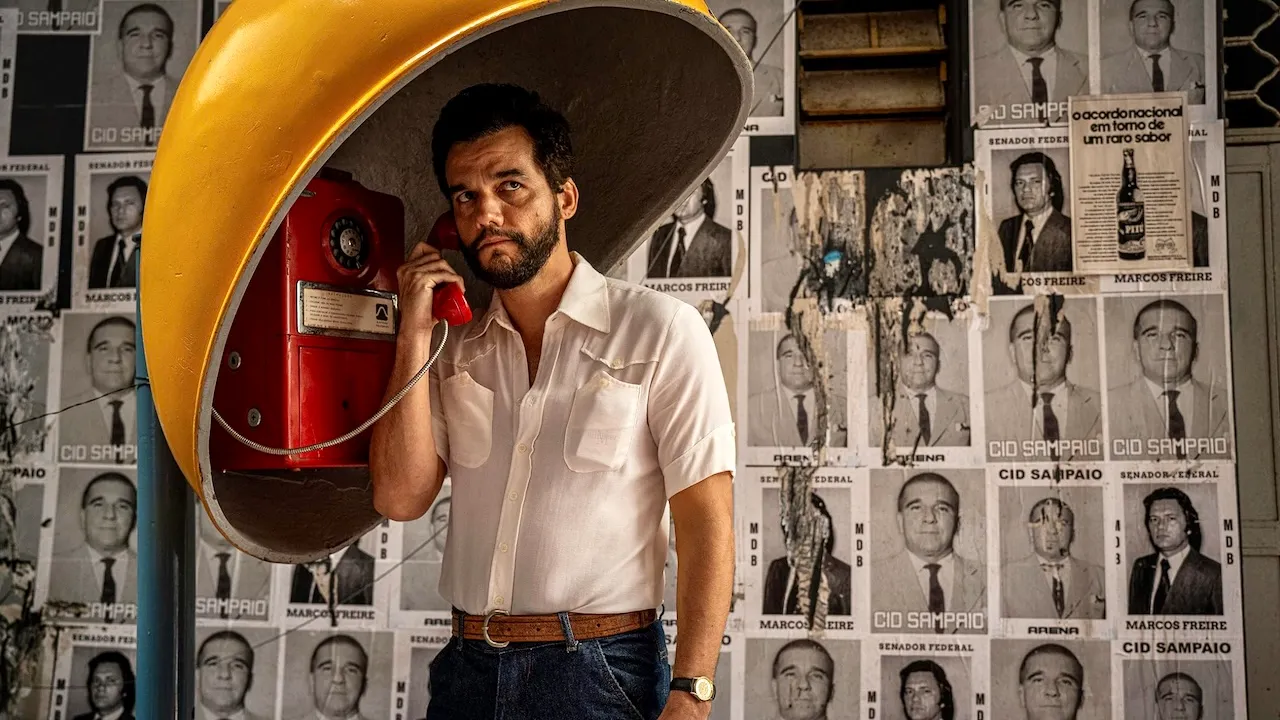
The Secret Agent (2025): Recife in 1977, and a country listening in
Kleber Mendonça Filho knows all of this. I say this because it’s the same Kleber who brought back Sônia Braga, a gigantic actress from the Brazilian classics of the 70s and 80s (cf. Dona Flor and Her Two Husbands, absolute Bahian masterpiece) who had already begun building an international career when he cast her as the polemic protagonist of Aquarius. I’m convinced there is some strategic thinking behind the filmmaker seeking out great talents forged in the depths of Brazilian audiovisual culture, talents who have, on top of that, already proven they can hold their own internationally. In doing so, Kleber makes his cinema of contact zones: unapologetically Brazilian, refusing to sand down the national rough edges to make life easier for gringo audiences, a cinema that defies the received image of Brazil. And precisely because of that, it’s the Brazilian cinema that is traveling furthest.

Had many lives, including screenwriter, cinema professor and goth teenager. Brazilian, drawn to intense movies, with low tolerance for biopics.