
Is ‘Ripley’ the Most Beautiful Television Series Ever Made?
Steven Zaillian and Robert Elswit built eight hours in which every gorgeous frame implicates the person enjoying it. Beauty as a moral instrument, not decor.
Ripley’s shadow reaches Dickie and Marge before he does. It is a wide shot on the beach at Atrani, the two of them arranged on the sand, and a long dark shape slides across their bodies from outside the frame. Nobody says anything. The show has just told you the entire plot in one gesture: a man is about to walk into someone else’s life, and he will arrive as an absence of light. Composition is doing the narrative work that eight episodes of dialogue could not.
That shot is the thesis of Steven Zaillian’s Ripley, and it explains why the show sits so far outside the prestige-television field it nominally belongs to. At a glance it is another Patricia Highsmith adaptation, another pass at Tom Ripley’s Italian crimes, the first version of that novel built as a series rather than a feature, after René Clément’s Purple Noon and Anthony Minghella’s 1999 film. Sit with it and something odder surfaces. It plays like a recovered artifact from Italian cinema’s post-war years, made by people who came back with modern equipment and old convictions. Every frame looks sharpened by intention. Robert Elswit’s cinematography earns the word beautiful, which is not a word streaming has much use for.
Beauty here is a hostile instrument. The show is relentlessly composed and almost never pretty. It refuses postcard Italy. It withholds the amber nostalgia that softened the 1999 film into something you could put on in the background. Zaillian and Elswit instead build an atmosphere where composition functions as a trap and elegance operates as camouflage for moral rot. That is what separates Ripley from the many series that reach for cinematic aspiration. It has no interest in resembling a movie. It is after something television has mostly abandoned.
Black and white is the show’s moral logic
Zaillian committed to monochrome before anything else, and his stated reason is a structural one: the story takes place in the winter of 1960 and carries a noir quality. Color softens Tom Ripley. Color is seductive, and seduction is already resident inside the character, so adding more of it just doubles a note. What the material needed was architecture, contrast, discipline. Black and white gives the show a spine.
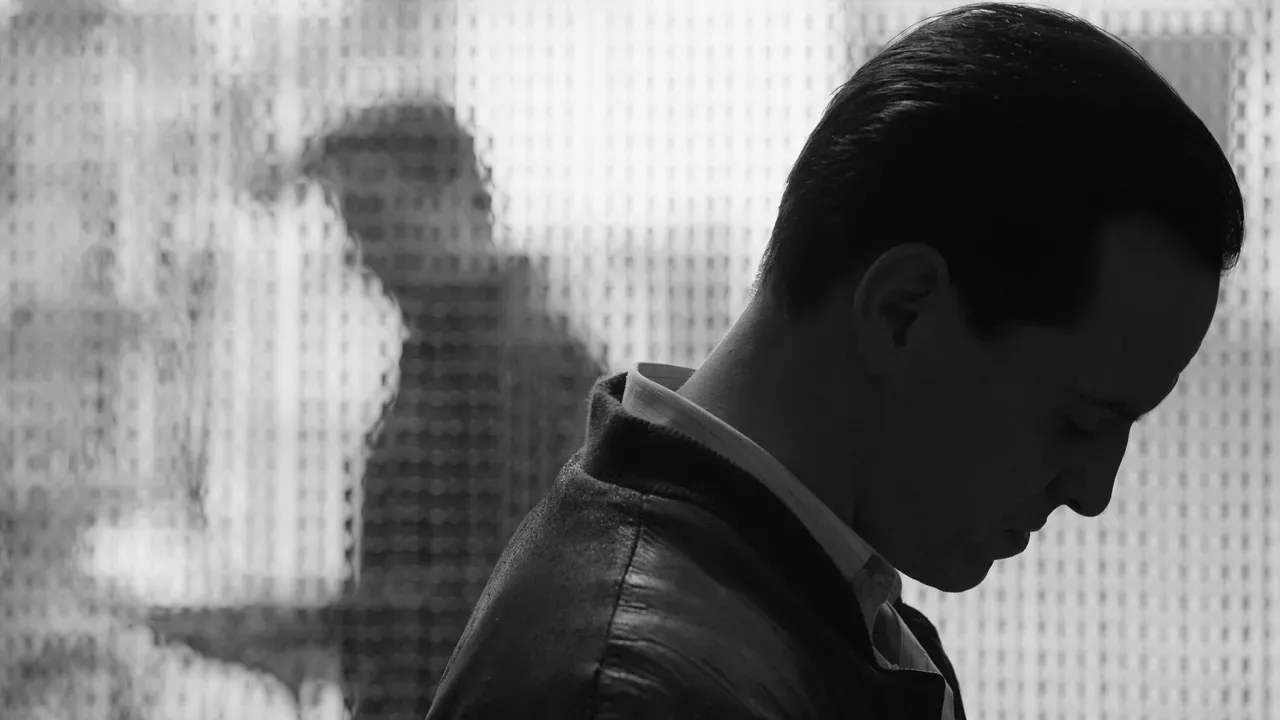
Andrew Scott as Tom Ripley, a man made of other people’s images, in Ripley (2024)
The execution is more interesting than the decision. Elswit did not shoot on black and white stock. He shot color on the Alexa LF at 1.78:1 and desaturated in post, running a custom monochrome LUT built at Company 3 out of two ingredients: Kodak 5231, a discontinued stock known for contrast and shadow detail, and Ferrania P30, the Italian stock that put the sixties on film in the first place. He then had his on-set monitors calibrated to the desaturated look so he could light to the final image rather than guess at it. He had done a version of this before, on Good Night, and Good Luck, also color capture converted to monochrome, also an Oscar nomination.
None of which would matter if the result were merely handsome. What Elswit does with hard light is the point. He lights with tungsten Fresnels and HMIs standing in for direct sun, sourcing everything from one direction so the shadows have edges. This is a universe where the stones of an Amalfi beach seem to glow with a cosmic emptiness and a stairwell in Naples reads as a portal into something ancient and malignant. Chiaroscuro has been imported wholesale into serialized storytelling. The images are not lit. They are carved.
The carving serves the character. Zaillian is putting you inside a consciousness that perceives morality in binaries and gradations of shadow, and the absence of color turns into the presence of tension. You are never permitted to drift into the warm Mediterranean of previous adaptations. You are held in a visual dialect that cannot let you forget Tom sees advantage everywhere, empathy nowhere, and a specific danger in any bright surface that might expose him.
Caravaggio is character logic, not art history
The Caravaggio material is Zaillian’s invention. It appears nowhere in Highsmith, and his explanation of why he added it is almost brutally simple: Caravaggio was another man who lived in Rome, murdered somebody, and went on the run for it. That is the parallel. Everything else follows from it.
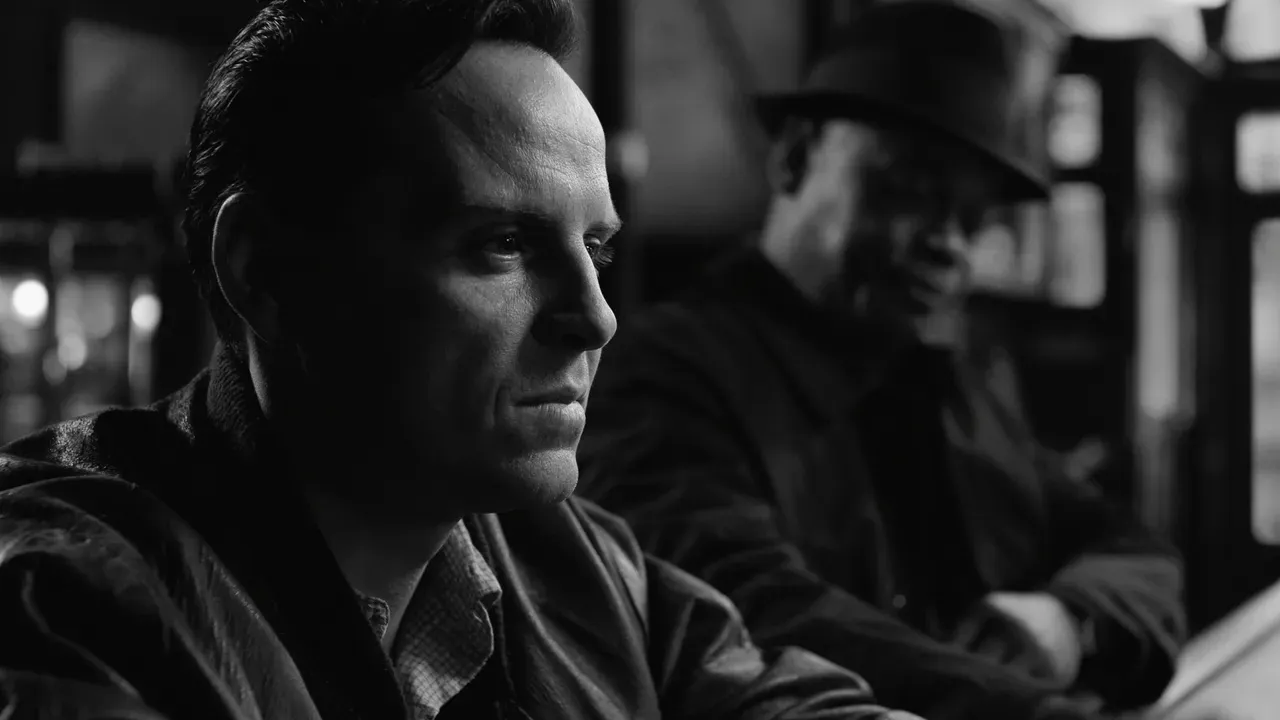
One source, hard, from one direction: Elswit’s Caravaggio grammar in Ripley (2024)
In episode two, Tom and Dickie stand in front of The Seven Acts of Mercy at the Pio Monte della Misericordia in Naples, and Dickie supplies the biographical detail about the painter finishing it a year after killing a man. Later, having committed a murder of his own, Tom looks at David with the Head of Goliath in the Galleria Borghese, a painting in which Caravaggio put his own face on the severed head. The show does not underline this. It just puts a killer in a room with a self-portrait as a corpse and lets him look.
The influence runs deeper than the two gallery scenes, into blocking and framing and rhythm. Caravaggio understood that light is strongest when it reveals the possibility of the abyss next to it, and that is the operating principle of the lighting throughout. It also aligns with the story’s fabric. Tom, like Caravaggio, is a creature of dual lives, capable of tenderness and butchery within the same hour, constantly reinventing himself and never once escaping the gravitational pull of his own impulses. He holds the painter up as a mirror. The show holds the painter up to us.
Consider what happens in the Italian churches, where the camera shrinks Tom into a small silhouette against enormous architecture. Those are moments of visual theology. They register his insignificance in the presence of the sublime while sharpening the perversity of what he has been doing with his afternoons. Television attempts ideas at this altitude rarely and lands them almost never.
Architecture is the second protagonist
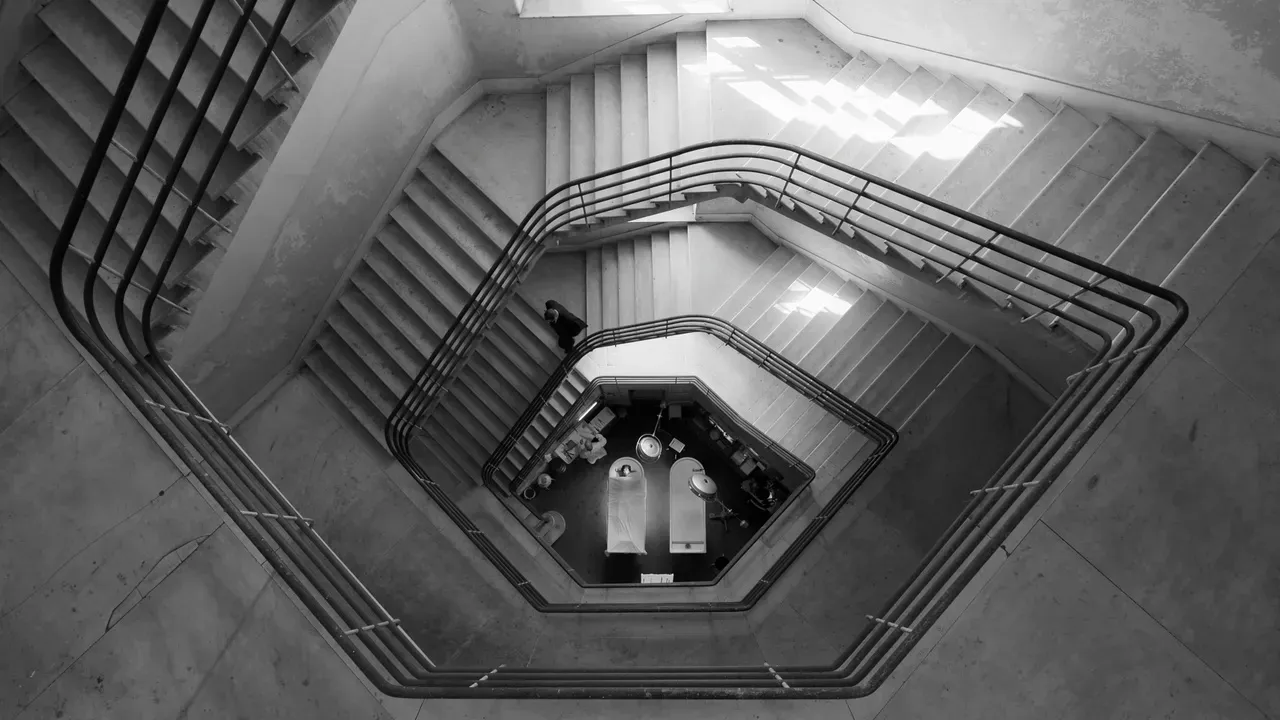
Zaillian directs from an obsession with vantage points. He treats rooms as psychological diagrams and staircases as existential corridors, and the show is stuffed with shots framed through arches, doorways, mirrors, and windows. Zaillian has described the habit plainly, saying he likes to see scenes from other rooms, framed inside a doorway or an arch or a stairwell, because it produces the feeling of observing rather than attending. This is the aesthetic of surveillance, conducted not by police but by the world. Ripley frequently feels like a collection of rooms watching a man who believes himself unwatchable.
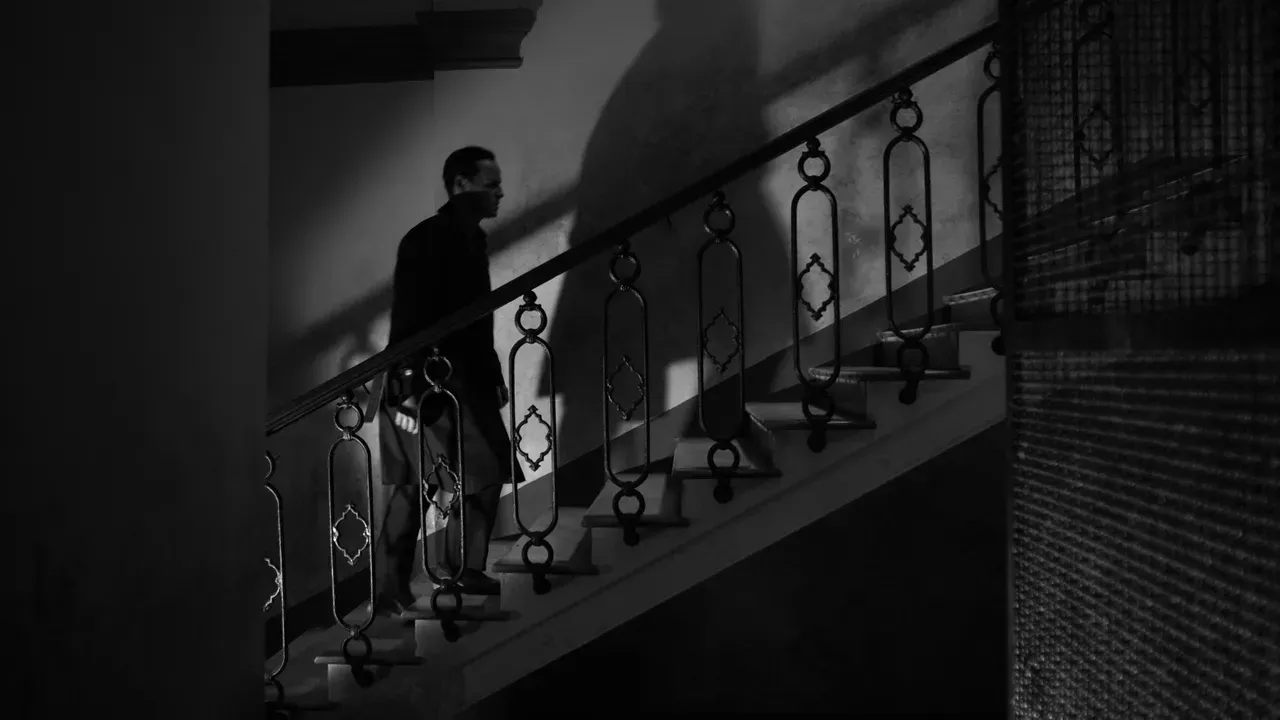
A staircase as an existential corridor, in Ripley (2024)
Elswit, who had shot episodes of The Night Of for him, and production designer David Gropman turn Italian architecture into the show’s other lead. The stone of Naples, the vertiginous stairs of old hotels, the serpentine alleys of Palermo. In color these textures might read as soft or romantic. Drained to monochrome they turn severe and faintly punitive, imposing verticality and weight on a man who is being measured, shot by shot, against structures built to outlast human deceit. Shooting in Italy in 2021 helped: Zaillian has noted there were no tourists, which made the locations feel further back in time than they are.
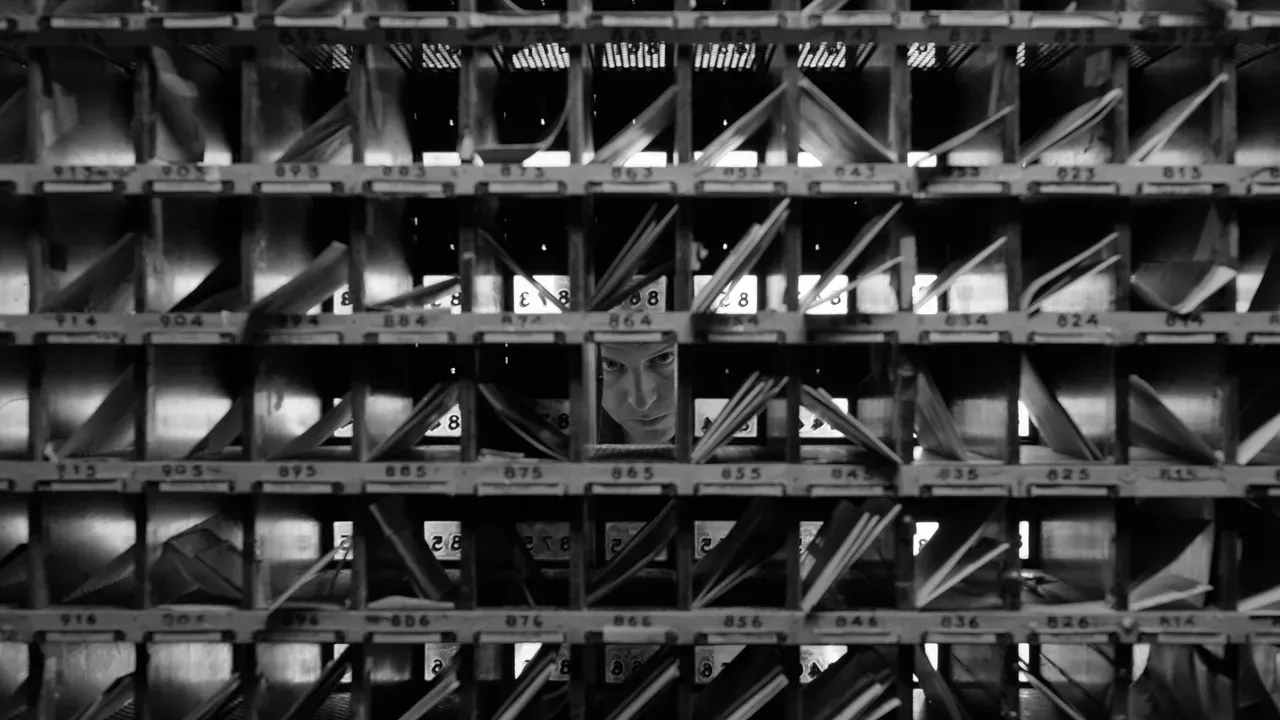
The rooms are watching him back, in Ripley (2024)
Andrew Scott’s face belongs to this system as much as any building does. Elswit and Zaillian use it the way a sculptor uses marble. Sometimes Scott is cherubic and nearly translucent. Sometimes he is a blank mask onto which the viewer projects threat, and the shift between those two states can be achieved with a small change in the angle of a key light. Having found that, they built a visual language around the instability of his face. It is the most efficient special effect in the show.
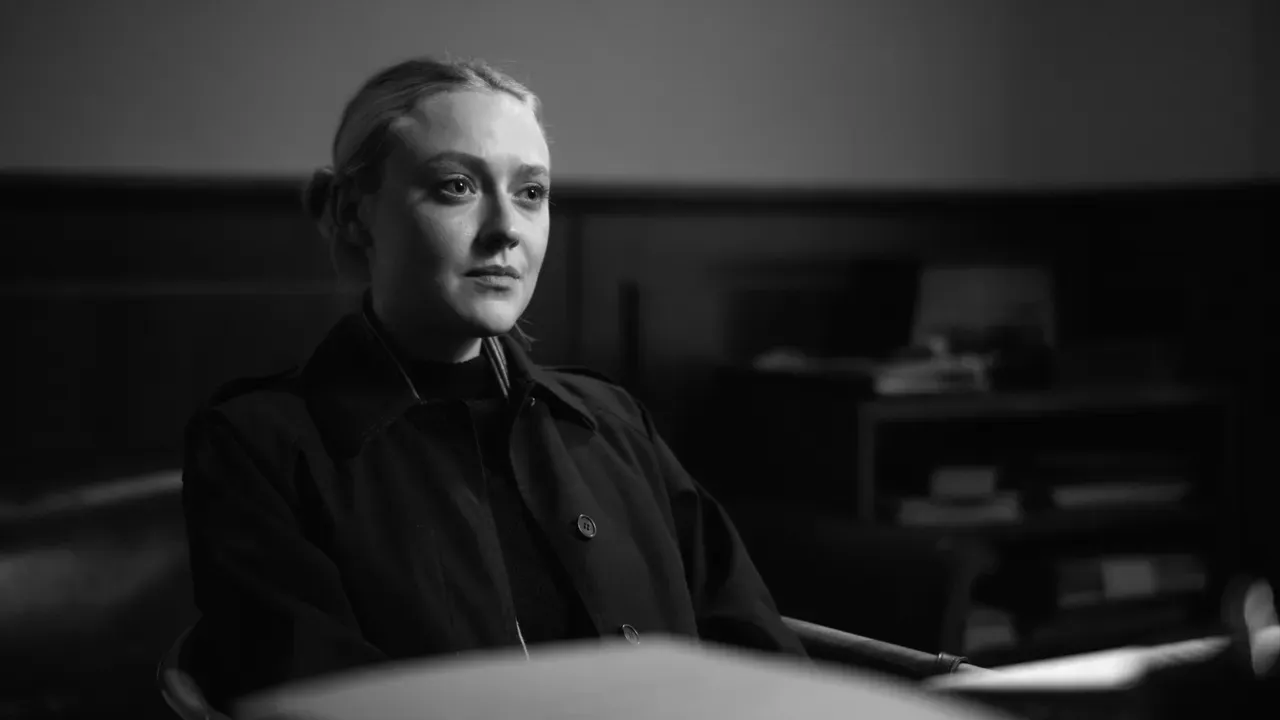
Dakota Fanning as Marge Sherwood, the one character the show keeps in clear light, in Ripley (2024)
Dakota Fanning’s Marge functions as the counterpoint. Her brightness, literal and temperamental, cuts hard against Tom’s shadowed interior, and she is one of the few characters the show routinely frames in direct light. The light is not warmth. It is clarity. Her suspicion lives in her stillness, in the way she watches him instead of confronting him, and the camera respects her intelligence enough to hold on it. Johnny Flynn’s Dickie is lit like a figure from a vintage Italian romance, and the glamour is both intentional and ironic. He is a fantasy Tom covets and despises at once. His beauty threatens because it costs him nothing. Tom’s beauty is constructed, strategic, permanently in negotiation with whatever room he is standing in. Dickie is the sun and Tom is the shadow, and in a monochrome world the shadow wins on points.
Stillness takes more nerve than pace
Television is frightened of stillness. A long static take reads as a risk in an era of algorithmic pacing, and most shows hedge by cutting. Zaillian ignores the pressure entirely and builds scenes that unfold in something close to real time, with a patient dread closer to Antonioni than to anything currently streaming. The long compositions force you to sit inside Tom’s lies and watch him invent himself line by line while the truth inches toward the room.
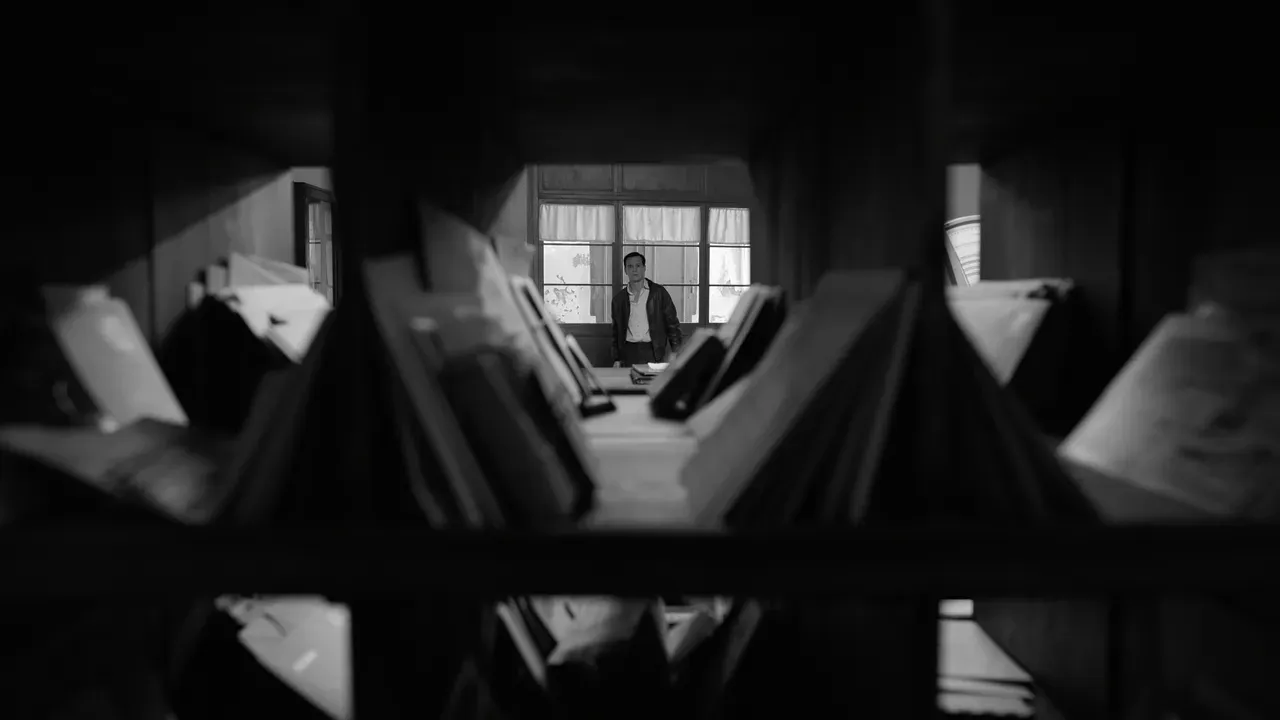
The camera declines to chase him, and waits instead, in Ripley (2024)
The stillness is functional. Tom is a man who lives in the quiet interval between panic and escape, and his crimes do not detonate. They seep into rooms, onto staircases, into the pauses in conversation. Elswit’s camera declines to chase him. It waits for him, which is a considerably more frightening arrangement.
The Television Academy gave the show four Emmys for the 76th ceremony, including directing for Zaillian and cinematography for Elswit, plus sound editing and visual effects. The visual effects win is the funny one. Nobody watches Ripley thinking about visual effects, which is the highest compliment available in that category.
Calling this one of the most beautiful shows ever made is not a compliment in the ordinary sense. The beauty here does not console. It accuses. It makes you complicit, because the show understands that aesthetic pleasure and moral disgust can occupy the same viewer at the same moment, and it has correctly identified that doubleness as the essence of Tom Ripley. Plenty of series aim at prestige. This one aims at permanence, and it invites comparison less to other Netflix dramas than to noir, neorealism, expressionism, and four centuries of European painting.
Ripley believes light can expose cruelty and shadow can expose truth, that architecture can carry fear and a face can turn with a shift of tone, and that how a thing is seen cannot be separated from what it means. Very few shows have believed all of that at once. Almost none have had the discipline to prove it. Beauty, aimed properly, is the most unsettling tool a storyteller owns, and Zaillian spent eight hours pointing it at us.

Film obsessive, photographer, and former Blockbuster Video clerk, currently living out every creative's dream of working in digital marketing.